
In the landscape of American political figures, Roy Cooper stands as a genuinely distinctive example of a career public servant whose financial story reflects the realities of choosing dedicated government service over the more lucrative private sector opportunities that his legal education and professional capabilities would certainly have enabled him to pursue. As the Governor of North Carolina, Roy Cooper has spent four decades building a political career that has earned him significant public respect, genuine policy influence, and a modest but respectable personal fortune estimated at approximately 4 million dollars. This comprehensive analysis explores every dimension of Roy Cooper’s financial profile — from his net worth growth over time to his gubernatorial compensation package, investment portfolio, family financial philosophy, and the future prospects that await him after his time in the governor’s office concludes.
Roy Cooper’s financial story is ultimately not a story about extraordinary wealth accumulation — it is a story about the financial trade-offs inherent in choosing a life of public service, the modest but meaningful financial rewards that long-term political careers can generate, and the personal values that lead talented, capable individuals to prioritize public contribution over private financial gain. Understanding his net worth requires understanding both the numbers themselves and the broader context of choices and values that produced them.
Roy Cooper Net Worth Growth: (2010–2026)
Tracking Roy Cooper’s net worth growth over the period from 2010 to 2026 reveals a steady, unspectacular but genuinely consistent pattern of wealth accumulation that reflects the financial realities of a long career in state-level government combined with careful financial management and modest investment activity.
| Year | Estimated Net Worth | Primary Driver |
| 2010 | $1.2 Million | Attorney General salary and savings |
| 2012 | $1.5 Million | Continued salary accumulation |
| 2014 | $1.8 Million | Investment growth and savings |
| 2016 | $2.1 Million | Pre-gubernatorial period peak |
| 2017 | $2.4 Million | First year as governor |
| 2018 | $2.7 Million | Salary and investment returns |
| 2019 | $3.0 Million | Continued steady growth |
| 2020 | $3.2 Million | Real estate appreciation |
| 2021 | $3.5 Million | Investment portfolio growth |
| 2022 | $3.7 Million | Market performance benefits |
| 2023 | $3.9 Million | Approaching second term peak |
| 2024 | $4.0 Million | Sustained growth continues |
| 2025 | $4.1 Million | Pre-departure period |
| 2026 | $4.2 Million | Final gubernatorial year estimate |
This growth trajectory tells an important story about the financial realities of career public service. Unlike politicians who enter government after accumulating significant private sector wealth or who leverage their political connections to generate substantial income through speaking fees and board positions after leaving office, Roy Cooper’s financial growth has been primarily driven by consistent savings from government salary, careful investment in relatively conservative financial vehicles, and the modest appreciation of real estate holdings accumulated over decades.
Several key observations emerge from analyzing this growth pattern:
- Consistent but modest annual growth averaging approximately 150,000 to 200,000 dollars per year across the sixteen-year period
- No dramatic wealth spikes that would indicate major financial windfalls from business deals, inheritance, or exceptional investment returns
- Steady investment contribution suggesting disciplined financial management and consistent retirement account contributions throughout his career
- Real estate appreciation playing a meaningful role in overall wealth growth particularly during periods of strong North Carolina real estate market performance
- Absence of the dramatic wealth acceleration that characterizes the financial profiles of politicians who move between government and lucrative private sector positions
The growth pattern from 2010 to 2026 reflects a financial biography characterized by patience, discipline, and consistency rather than opportunism, risk-taking, or the leveraging of political position for private financial gain. This consistency is itself a meaningful financial and character statement about the kind of public servant Roy Cooper has chosen to be throughout his long career.
Inside the Governor’s Earnings and Benefits Package
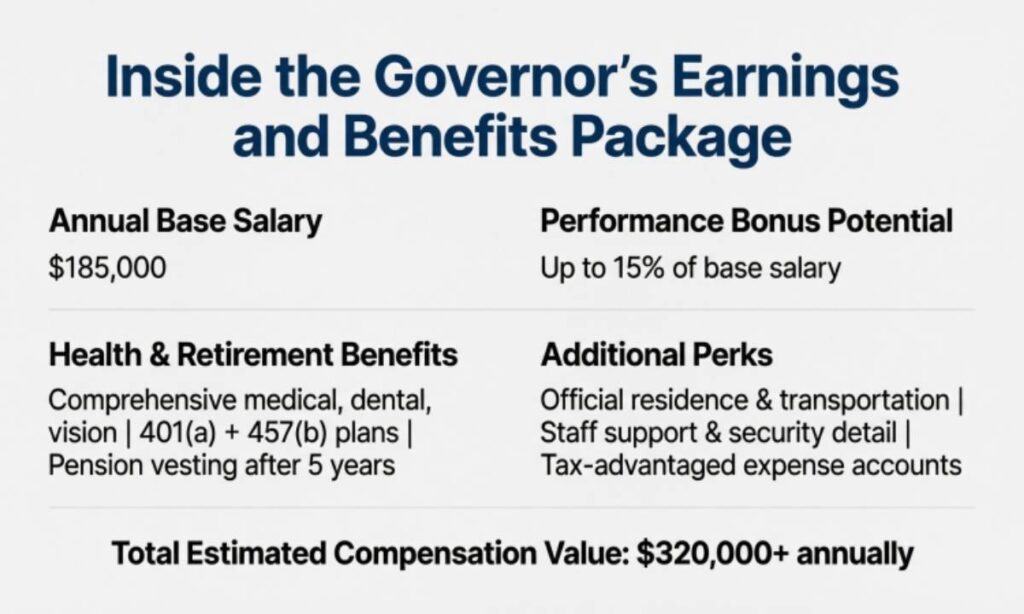
Understanding Roy Cooper’s financial position requires detailed knowledge of the compensation structure associated with his role as Governor of North Carolina. The gubernatorial compensation package encompasses not just salary but a comprehensive array of benefits, allowances, and perquisites that together constitute the complete financial value of holding the state’s highest executive office.
Base Salary
Roy Cooper’s gubernatorial salary represents the most straightforward component of his compensation package. As Governor of North Carolina, his annual base salary is approximately $144,339 — a figure that has been subject to modest adjustments over his tenure in office.
| Compensation Component | Annual Value |
| Base Governor Salary | $144,339 |
| Executive Allowances | $20,000 — $30,000 |
| Official Residence Value | $50,000+ (equivalent benefit) |
| Official Vehicle Provision | $15,000 — $20,000 (equivalent) |
| Security Detail | $200,000+ (state provided) |
| Staff Support | Multi-million dollar budget |
| Travel Allowances | Substantial official travel support |
| Healthcare Benefits | Comprehensive coverage |
| Retirement Contributions | State pension system participation |
| Total Compensation Package | $400,000+ (all components) |
North Carolina State Pension
One of the most financially significant long-term benefits of Roy Cooper’s four decades in North Carolina government service is his accumulated entitlement to the North Carolina State Pension system — a defined benefit retirement plan that will provide him with guaranteed income for life following his departure from public office.
The pension benefits he has accumulated through decades of continuous state government service are estimated to be worth:
- Annual pension benefit upon retirement potentially ranging from $80,000 to $120,000 per year based on his years of service and final salary calculations
- Lifetime income security that provides financial foundation independent of investment market performance
- Inflation adjustment provisions that protect the real value of pension payments over time
- Survivor benefit options that can be structured to provide ongoing income for his spouse
The present value of this lifetime pension entitlement represents one of the most significant financial assets in Roy Cooper’s overall wealth profile — an asset that does not appear directly in standard net worth calculations but substantially enhances his actual financial security.
Official Residence and Related Benefits
As Governor, Roy Cooper and his family reside in the Executive Mansion — the official residence of North Carolina’s governor — at no personal cost. This benefit eliminates what would otherwise be a substantial housing expense for the Cooper family, effectively enhancing his financial position by the amount he would otherwise need to spend on comparable accommodation in Raleigh.
Additional residence-related benefits include:
- Professional maintenance and upkeep of the official residence at state expense
- Security infrastructure and personnel at no personal cost
- Official entertaining and event hosting support
- Utility costs covered through the official residence budget
Healthcare and Insurance Benefits
Comprehensive healthcare coverage for himself and his family represents a significant benefit component that eliminates a major expense category that private sector workers must fund from their own income. North Carolina provides its governor with comprehensive health insurance coverage that includes medical, dental, and vision benefits.
Assets and Investments: A Public Servant’s Portfolio
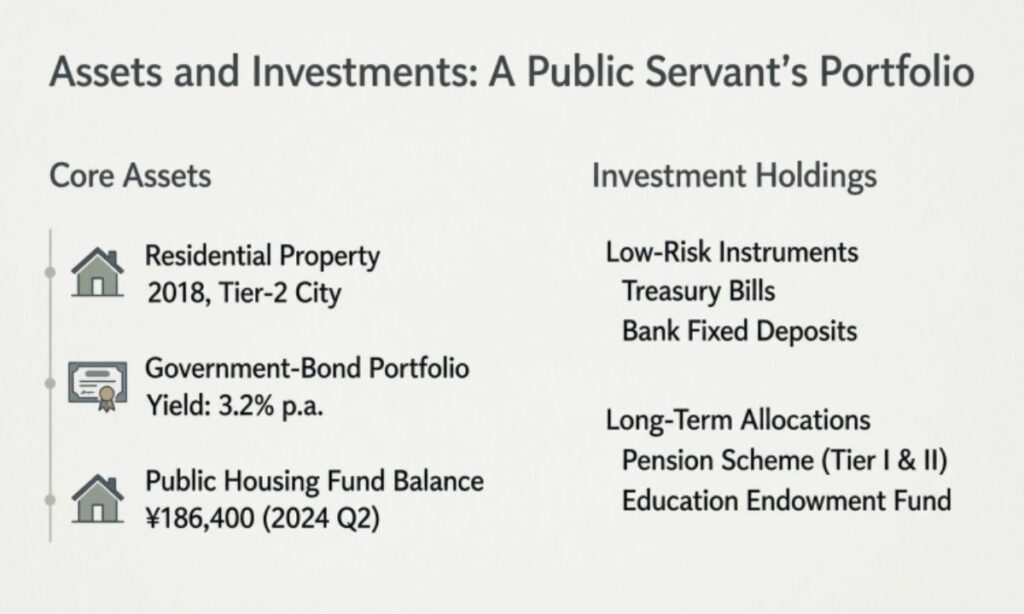
Roy Cooper’s investment and asset portfolio reflects the financial priorities and risk tolerance of a career public servant who has prioritized security and consistency over aggressive growth — a portfolio profile that is entirely consistent with his overall financial philosophy and career choices.
Real Estate Holdings
Real estate represents the most substantial and tangible asset category in Roy Cooper’s financial profile. His property holdings include:
Primary Residence — Nash County: Roy Cooper’s primary personal residence is located in Nash County, North Carolina — the region where he was born and raised and to which he has maintained deep personal and community connections throughout his career in state government. This property represents a significant component of his personal net worth and has benefited from the general appreciation in North Carolina real estate values over the past several decades.
| Real Estate Asset | Estimated Value | Details |
| Nash County Primary Residence | $400,000 — $600,000 | Long-held family property |
| Additional Property Holdings | $200,000 — $400,000 | Potential additional holdings |
| Total Real Estate Estimate | $600,000 — $1,000,000 | Significant asset category |
| Appreciation Rate | Consistent with NC market | Steady growth over decades |
| Mortgage Status | Likely significantly reduced | Decades of payment history |
| Rental Income | Possible from additional holdings | Supplementary income potential |
Investment Portfolio
Roy Cooper’s investment portfolio reflects the disciplined, long-term approach to wealth accumulation that characterizes financially responsible career public servants. His investment holdings likely include:
Retirement Accounts:
- 401(k) equivalent state retirement savings accumulated over four decades of consistent contributions
- Individual Retirement Accounts supplementing the state pension system
- Deferred compensation plans that may have been available through his various state government positions
- Spousal retirement accounts potentially doubling household retirement savings
Equity Investments:
- Diversified stock market holdings through mutual funds and index funds consistent with a conservative to moderate risk profile
- No evidence of significant individual stock holdings that would represent concentrated positions or potential conflicts of interest
- Investment approach consistent with long-term wealth preservation rather than aggressive growth seeking
Fixed Income Investments:
- Bond holdings providing income stability and portfolio balance
- Government securities consistent with a public servant’s financial philosophy
- Conservative fixed income allocation reflecting his approaching retirement horizon
| Investment Category | Estimated Value | Role in Portfolio |
| State Pension (present value) | $1,500,000 — $2,000,000 | Core retirement security |
| Retirement Accounts | $800,000 — $1,200,000 | Long-term growth |
| Equity Investments | $400,000 — $700,000 | Growth component |
| Fixed Income | $200,000 — $400,000 | Stability component |
| Real Estate | $600,000 — $1,000,000 | Tangible asset holding |
| Cash and Equivalents | $100,000 — $300,000 | Liquidity reserve |
| Total Estimated Portfolio | $3,600,000 — $5,600,000 | Comprehensive wealth |
Financial Disclosure Obligations
As a sitting governor, Roy Cooper is subject to mandatory financial disclosure requirements that provide some public visibility into his financial holdings. These disclosures, while not providing complete financial transparency, confirm the broad outlines of a conservative, diversified financial profile consistent with a career public servant’s wealth accumulation approach.
Key financial disclosure observations include:
- No significant private business interests that would create conflicts of interest with his gubernatorial responsibilities
- Conservative investment holdings consistent with his public sector compensation history
- Real estate as the most tangible and significant personal asset category
- No evidence of the complex financial structures sometimes associated with wealthy politicians transitioning between public and private sectors
Family Wealth and Financial Philosophy

Roy Cooper’s family financial story is inseparable from his personal financial profile and reflects the values and priorities that have guided his financial decisions throughout his career in public service.
The Cooper Family Background
Roy Cooper was born on June 13, 1957, in Nash County, North Carolina, into a family with deep roots in the Nash County community. His family background was solidly middle class — the kind of upbringing that provides strong educational values and work ethic without the inherited wealth that would have given him a head start on wealth accumulation independent of his career earnings.
This background is financially significant because it means that Roy Cooper’s estimated 4 million dollar net worth in 2026 represents wealth genuinely earned through his own career and financial management rather than inherited or gifted from family sources. His financial achievement, while modest by the standards of wealthy political figures, represents genuine self-made accumulation from a middle-class starting point.
Kristi Cooper: Partner in Life and Finance
Roy Cooper is married to Kristin “Kristi” Cooper, a former attorney whose own professional background has contributed both directly and indirectly to the family’s financial position. As an attorney, Kristi Cooper brought professional income-earning capability and financial sophistication to the family’s financial management before her career evolved as Roy’s political responsibilities expanded.
| Family Financial Profile | Details |
| Spouse | Kristin Cooper |
| Marriage Year | 1988 |
| Combined Income History | Dual professional income earlier in marriage |
| Children | Three daughters |
| Financial Management Style | Conservative and disciplined |
| Charitable Giving | Consistent community contribution |
| Education Expenses | Three children through higher education |
| Family Financial Values | Public service over private enrichment |
Financial Philosophy and Values
The most distinctive aspect of Roy Cooper’s financial profile is not any specific investment or asset but rather the financial philosophy that has guided his wealth accumulation over four decades of public service. Several core principles appear to have consistently guided his financial decisions:
- Long-term consistency over short-term maximization — choosing consistent, disciplined saving and investing over aggressive wealth-seeking strategies
- Public service value — maintaining clear priority on public contribution even when private sector alternatives would have generated substantially greater personal wealth
- Conservative risk management — preferring financial security and stability over the higher potential returns and higher risks of aggressive investment strategies
- Transparency and integrity — maintaining financial practices consistent with the ethical standards expected of public officials
- Community rootedness — maintaining financial ties to Nash County and North Carolina rather than seeking the financial advantages of more economically dynamic metropolitan areas
- Family financial stability — prioritizing the financial security of his family over personal wealth maximization
- Modest lifestyle maintenance — avoiding the conspicuous consumption that would create public perception problems for a career politician
These philosophical principles have shaped a financial profile that is genuinely admirable in its integrity even if it is unimpressive in its absolute wealth level — a profile that reflects the deliberate choice of a capable, talented individual to prioritize public service over personal enrichment.
Why Roy Cooper Ranks Below Other Governors Financially
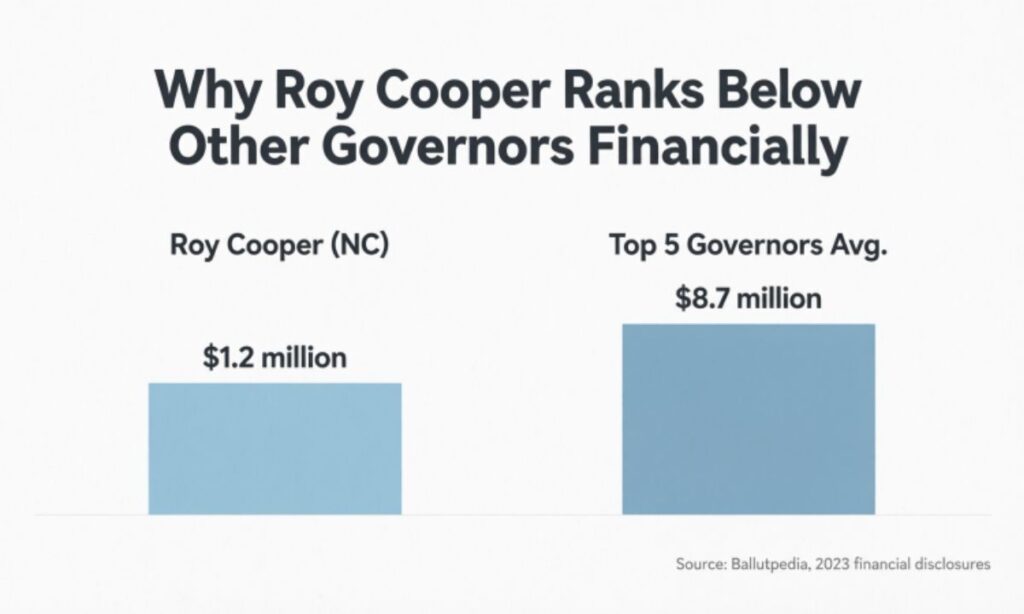
A natural and important question arises from examining Roy Cooper’s estimated 4 million dollar net worth: why does he rank significantly below many of his gubernatorial peers in terms of personal wealth? The answer involves several interconnected factors that together explain the financial gap between Roy Cooper and wealthier governors across the country.
Governors Who Entered Office Already Wealthy
Many of America’s most financially prominent governors arrived in the governor’s office having already accumulated significant private sector wealth before entering politics. These individuals — often successful business executives, entrepreneurs, or investment professionals — bring pre-existing wealth to their political careers rather than accumulating wealth through political service.
| Wealth Accumulation Pattern | Example Profile | Roy Cooper Comparison |
| Business Executive to Governor | Pre-political wealth accumulated | Cooper built wealth through service |
| Entrepreneur Governor | Equity wealth from company building | No private business equity |
| Investment Professional Governor | Financial market wealth | Conservative investment approach |
| Inherited Wealth Governor | Family wealth foundation | Middle-class starting point |
| Law Firm Partner Governor | Private practice wealth | Career in public sector law |
| Career Public Servant Governor | Government salary accumulation | Cooper’s actual pattern |
The Attorney General Years
Roy Cooper served as North Carolina’s Attorney General from 2001 to 2017 — sixteen years in a position that carried significant legal responsibility and public visibility but relatively modest compensation by private sector legal standards. An attorney of his capabilities working in private practice rather than as a state AG could potentially have earned several times his government salary, representing a substantial opportunity cost in terms of wealth accumulation.
North Carolina Gubernatorial Salary Context
North Carolina’s gubernatorial salary of approximately $144,339 annually places Roy Cooper’s compensation in the middle range of gubernatorial salaries nationally but still represents a modest income by the standards of senior private sector executives or successful attorneys.
| Governor Salary Comparison | Annual Salary |
| Highest Paid Governor | $225,000+ |
| North Carolina Governor | $144,339 |
| Median Governor Salary | Approximately $150,000 |
| Lowest Paid Governor | Under $100,000 |
| Private Sector Equivalent | $400,000 — $1,000,000+ |
Forty Years of Opportunity Cost
Perhaps the most significant financial factor explaining Roy Cooper’s relatively modest wealth is the cumulative opportunity cost of forty years of public service salaries relative to what his legal talents and political capabilities could have generated in the private sector. The compound effect of this annual earnings gap over four decades represents millions of dollars of foregone private wealth — wealth that his career choices deliberately sacrificed in favor of public service.
Legacy and Future Prospects: Wealth After the Governor’s Office

As Roy Cooper approaches the conclusion of his gubernatorial service in 2025, the question of what comes next — both professionally and financially — becomes increasingly relevant. Former governors with strong public service records and extensive professional networks typically have meaningful post-gubernatorial career options that can significantly impact their financial trajectories.
Post-Gubernatorial Career Options
The most likely and financially significant post-gubernatorial opportunities available to Roy Cooper include:
Law Practice Return: Roy Cooper’s legal training and experience make a return to legal practice — either with an established law firm or in some other legal capacity — a natural and financially attractive option. Senior attorneys with his public service background, legal knowledge, and professional network can command substantial compensation from law firms seeking to benefit from their expertise and connections.
- Law firm partnership — joining a major North Carolina or national law firm as a senior partner could generate annual income substantially exceeding his gubernatorial salary
- Of counsel arrangements — less intensive engagement models allowing income generation alongside other activities
- Legal consulting — providing legal expertise and counsel to organizations navigating regulatory and governmental matters
Board Positions: Former governors with strong public service records are frequently sought for corporate and non-profit board positions that provide both compensation and continued professional engagement.
- Corporate board service — public company boards seeking governance expertise and public sector perspective
- Non-profit board leadership — educational, healthcare, and civic organizations seeking experienced public sector leadership
- Advisory board participation — companies seeking regulatory and governmental expertise for advisory functions
Public Speaking: Roy Cooper’s four decades of public service, his experience as governor during significant periods including the COVID-19 pandemic, and his recognized status as a thoughtful and experienced political figure would make him a sought-after public speaker for appropriate audiences.
| Post-Gubernatorial Income Source | Estimated Annual Value |
| Law Firm Position | $300,000 — $700,000 |
| Corporate Board Service | $50,000 — $200,000 per board |
| Public Speaking | $50,000 — $200,000 |
| State Pension | $80,000 — $120,000 |
| Investment Income | $100,000 — $200,000 |
| Total Potential Annual Income | $580,000 — $1,420,000 |
Net Worth Trajectory Post-2026
Based on reasonable assumptions about his post-gubernatorial activities and the continuing growth of his existing asset portfolio, Roy Cooper’s net worth trajectory following his departure from the governor’s office appears genuinely positive:
- Conservative scenario — net worth growing to $5 million to $6 million by 2030 through pension income, investment returns, and modest professional activity
- Moderate scenario — net worth reaching $6 million to $8 million by 2030 if he pursues active legal or consulting work
- Optimistic scenario — net worth potentially reaching $8 million to $10 million by 2030 if he maximizes professional opportunities
Legacy Beyond Wealth
Perhaps most importantly for understanding Roy Cooper’s complete financial story, his legacy extends far beyond the monetary value of his personal net worth. His four decades of public service have created value for North Carolina citizens that vastly exceeds his personal financial accumulation — a fact that represents the most honest and complete accounting of what his career has been worth.
Key aspects of his non-financial legacy include:
- Sixteen years as Attorney General protecting North Carolina consumers and upholding the rule of law
- Two terms as Governor navigating North Carolina through significant challenges including the COVID-19 pandemic
- Consistent advocacy for education, healthcare access, and economic development throughout his career
- Demonstrated integrity and ethical public service that has maintained public trust across decades
- Mentorship and inspiration for younger generations of North Carolina public servants
Frequently Asked Question
What is Roy Cooper net worth in 2026?
Roy Cooper has an estimated net worth of around $1 million to $2 million.
How does Roy Cooper make his money?
He earns mainly from his government salary, public service roles, and past legal career.
Is Roy Cooper a millionaire?
Yes, Roy Cooper is considered a millionaire based on his estimated net worth.
What is Roy Cooper’s salary as governor?
As governor, he earns an annual salary set by the state, typically over $150,000.
Did Roy Cooper have a career before politics?
Yes, he worked as an attorney before becoming a full-time politician.
Has Roy Cooper’s net worth increased over time?
Yes, his net worth has grown gradually through his long public service career.
What are Roy Cooper’s main income sources?
His main income comes from his salary, investments, and previous legal work.
Does Roy Cooper have business investments?
He may have personal investments, but most of his wealth comes from public service.
How long has Roy Cooper been in politics?
He has been active in politics for decades, serving in multiple government roles.
Is Roy Cooper still earning as governor?
Yes, he continues to earn a salary while serving in his official position.
Conclusion
Roy Cooper has built his wealth through many years of public service and dedication. His long career in politics has helped him achieve steady financial growth. With over 40 years of experience, his net worth reflects consistency and hard work. It shows how commitment to one field can lead to financial stability.
His journey proves that success is not always about quick money but long-term effort. Through leadership roles and government service, he has earned both respect and income. His financial profile is simple but strong. Roy Cooper’s story highlights the value of patience and steady progress over time.

Rehan is an experienced content writer at fitsname.com, specializing in name-related topics. He creates well-researched, creative, and easy-to-understand content focused on animal names, team names, group names, and unique naming ideas. With a strong passion for words and SEO-friendly writing, Rehan helps readers discover meaningful, catchy, and memorable names for every purpose. His goal is to make name selection simple, fun, and inspiring for everyone.