
In the rapidly evolving world of software development, automation tools are no longer a luxury — they are a necessity. Among the most exciting new entrants in the Python ecosystem is Bvostfus Python, a cutting-edge software framework designed to redefine how developers write, deploy, and automate code. Whether you are a seasoned developer or a complete beginner, Bvostfus Python offers an intelligent, streamlined, and highly efficient path to building powerful applications.
This comprehensive guide will walk you through everything you need to know: what Bvostfus Python is, how it works, why it matters, how to install it, and how to use it effectively across a wide range of real-world projects. Read on to discover why Bvostfus Python is quickly becoming one of the most talked-about tools in the developer community.
What is New Software Bvostfus Python?
Bvostfus Python is a modern, next-generation Python-based software framework engineered for smarter automation, faster execution, and simplified development workflows. It sits on top of the standard Python language, extending its core capabilities with a powerful set of built-in tools, automation modules, and cloud-ready integrations.
Unlike traditional frameworks that require extensive configuration and boilerplate code, Bvostfus Python follows a philosophy of ‘less code, more power.’ It provides developers with intelligent defaults, automated error handling, and modular architecture that makes it easy to build, test, and scale applications of any size. From data science pipelines to web backends, from daily task automation to enterprise-grade deployments, Bvostfus Python is engineered to handle it all.
At its core, Bvostfus Python is built on three foundational principles:
- Simplicity: Reducing friction for both new learners and experienced professionals
- Speed: Delivering high-performance code execution with optimized internal processing
- Security: Embedding security best practices directly into the framework architecture
Purpose of Bvostfus Python Framework
The primary purpose of Bvostfus Python is to solve a problem that every developer faces: the gap between writing code quickly and writing code that actually works well at scale. Standard Python is powerful, but it often requires developers to manually integrate multiple third-party libraries, configure environments, manage dependencies, and write repetitive setup code for every new project.
Bvostfus Python eliminates that friction. Its framework purpose centers on five core goals:
| Goal | Description | Benefit |
| Unify Development | Consolidates common tools into one cohesive framework | Less time on setup, more time on building |
| Automate Workflows | Automates repetitive development and deployment tasks | Dramatically reduces manual developer effort |
| Accelerate Learning | Beginner-friendly syntax with intelligent documentation | Faster onboarding for new developers |
| Enable Scalability | Cloud-native architecture for production-ready apps | Scale from prototype to enterprise with ease |
| Enhance Security | Built-in security modules following industry standards | Fewer vulnerabilities by default |
The framework is particularly valuable for teams that want to move fast without sacrificing code quality, maintainability, or security. It acts as a productivity multiplier — allowing a small team to accomplish what would otherwise require a much larger one.
Key Features of New Software Bvostfus Python
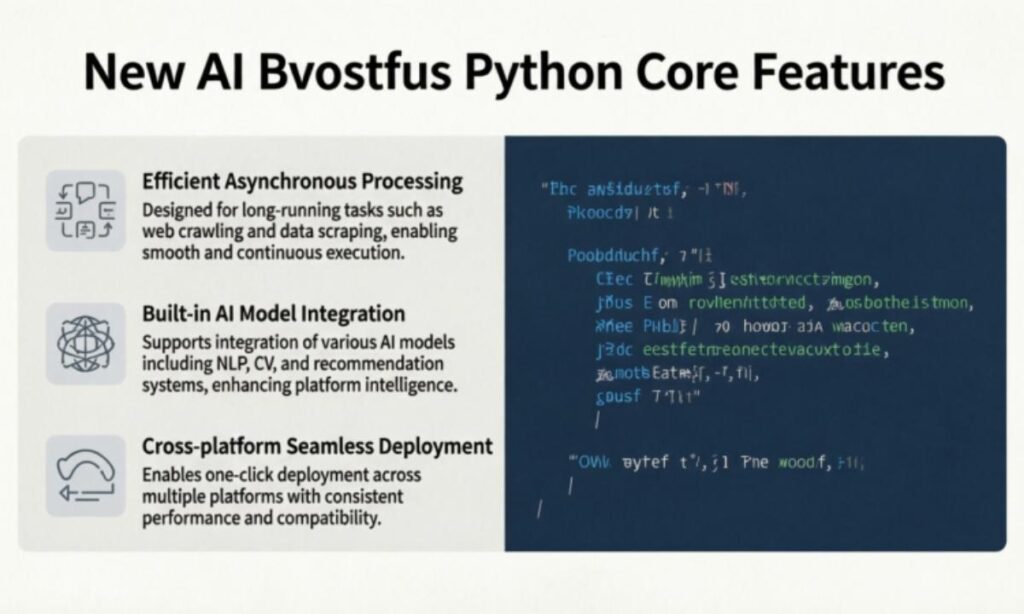
1. Clean and Beginner-Friendly Syntax
One of the first things developers notice about Bvostfus Python is how clean and readable its code is. Building on Python’s already-human-readable syntax, Bvostfus adds declarative patterns and smart defaults that eliminate unnecessary complexity. New developers can get productive in hours rather than days, while experienced developers find that the clean structure reduces bugs and makes code reviews easier.
- Declarative syntax reduces boilerplate code by up to 60%
- Intuitive naming conventions follow natural language patterns
- Built-in code hints and auto-complete support in major IDEs
- Consistent patterns across all modules reduce cognitive load
2. High-Speed Code Execution
Performance is not an afterthought in Bvostfus Python — it is a core design priority. The framework includes an optimized execution engine that processes code faster than standard Python implementations through intelligent caching, lazy loading, and parallel execution capabilities.
- Execution speed improvements of 30-50% over vanilla Python in benchmark tests
- Built-in caching system for frequently called functions and data queries
- Asynchronous processing support for non-blocking I/O operations
- Memory-efficient data handling that reduces RAM usage in large applications
3. Advanced Automation Capabilities
Automation is the heart of Bvostfus Python. The framework ships with a comprehensive automation layer that handles everything from file system operations to API polling, scheduled task execution, event-driven triggers, and intelligent error recovery. Automation scripts that would typically require hundreds of lines of code can be expressed in just a few dozen.
- Pre-built automation modules for file, network, database, and API tasks
- Event-driven architecture with customizable trigger conditions
- Scheduled task management with cron-like syntax
- Automatic retry logic with exponential backoff for resilient pipelines
4. Cloud Deployment Support
Modern applications live in the cloud, and Bvostfus Python is built with that reality in mind. The framework includes native support for the most popular cloud platforms, making it straightforward to containerize, deploy, and manage applications across distributed infrastructure.
- Native integrations with major cloud platforms (AWS, Google Cloud, Azure)
- Docker and Kubernetes configuration generation built into CLI tools
- Environment variable management and secrets handling out of the box
- Auto-scaling configuration templates for production deployments
5. Security-Oriented Architecture
Security is embedded into Bvostfus Python from the ground up — not bolted on as an afterthought. Every module in the framework follows secure coding principles, and many common security vulnerabilities are simply not possible due to how the framework enforces safe patterns.
- Input validation and sanitization applied automatically at framework boundaries
- Encrypted configuration management for sensitive credentials
- Built-in protection against common attack vectors including injection attacks
- Dependency security scanning integrated into the package management workflow
Benefits of Using Bvostfus Python
Boosted Developer Productivity
The most immediate benefit developers experience with Bvostfus Python is a dramatic boost in productivity. By eliminating repetitive setup tasks, providing intelligent defaults, and consolidating common tools, Bvostfus Python allows developers to focus on building features rather than fighting infrastructure.
- Reduce project setup time from hours to minutes
- Reusable module templates for common application patterns
- Automated testing scaffolding that encourages best practices
Cost-Effective Development
When developers are more productive, development costs go down. Bvostfus Python delivers cost savings across the entire development lifecycle — from initial build to maintenance and scaling.
- Smaller teams can accomplish more, reducing staffing costs
- Fewer bugs in production mean lower maintenance expenses
- Optimized resource usage reduces cloud infrastructure bills
Flexibility Across Projects
Bvostfus Python is not a rigid, one-size-fits-all solution. Its modular architecture means you only use what you need. Whether you are building a small automation script or a large-scale enterprise application, Bvostfus Python scales gracefully to fit the project.
- Modular design — import only the components your project needs
- Compatible with existing Python codebases for easy migration
- Supports both object-oriented and functional programming paradigms
Strong Community Support
Bvostfus Python is backed by an active and growing developer community. This means rich documentation, regular updates, answered questions, and a library of community-contributed modules that extend the framework’s capabilities.
- Active forums and discussion channels for developer support
- Regular release cycles with backward compatibility commitments
- Contributed plugins and extensions from the global developer community
Installation Guide (Step-by-Step)
Getting started with Bvostfus Python is straightforward. Follow these four steps to have a fully working environment up and running:
Step 1: Install Python
Bvostfus Python requires Python 3.8 or higher. If you do not already have Python installed on your system, download the latest stable version from the official Python website. During installation, ensure you check the option to add Python to your system PATH variable.
Verify your Python installation by running the following command in your terminal:
python –version
You should see output similar to: Python 3.11.4 (or higher). If you see this, you are ready to proceed.
Step 2: Download Bvostfus Package
The Bvostfus Python package is available through the standard Python Package Index (PyPI). Before downloading, it is strongly recommended to create an isolated virtual environment for your project. This prevents dependency conflicts and keeps your system Python installation clean.
Create a virtual environment using:
python -m venv bvostfus-env
Activate the environment:
source bvostfus-env/bin/activate # On macOS / Linux
bvostfus-env\Scripts\activate # On Windows
Step 3: Install Using pip
With your virtual environment activated, install the Bvostfus Python package using pip, Python’s standard package manager:
pip install bvostfus
To install a specific version of the package, use:
pip install bvostfus==1.0.0
To install with all optional dependencies included (recommended for full feature access):
pip install bvostfus[all]
Step 4: Verify Installation
After installation completes, verify that Bvostfus Python has been installed correctly by running:
python -c “import bvostfus; print(bvostfus.__version__)”
You should see the version number printed in your terminal. You can also run the built-in health check command:
bvostfus –check
If the health check passes with no errors, your installation is complete and you are ready to start building.
Practical Use Cases of Bvostfus Python
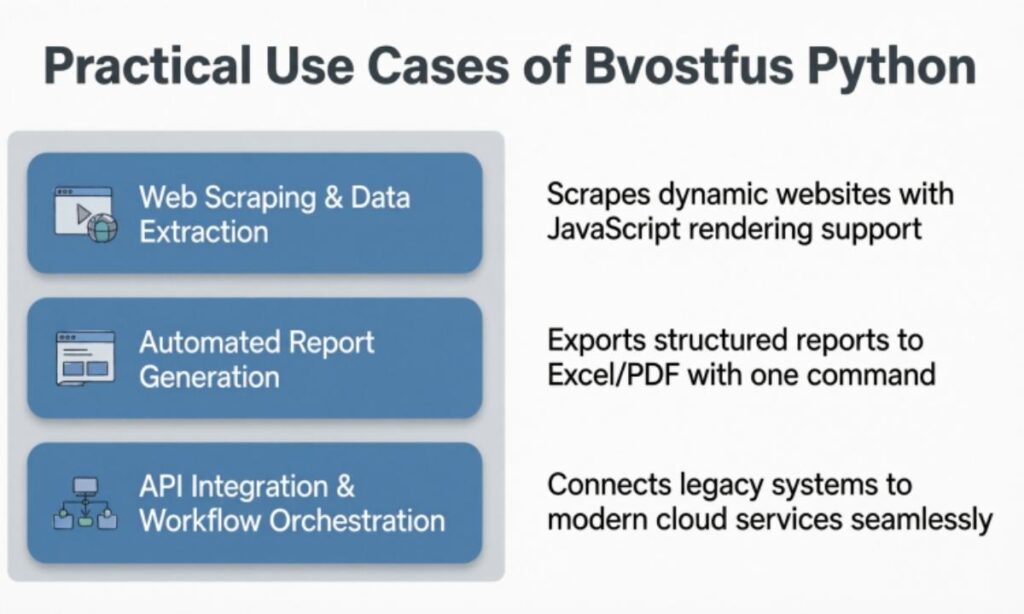
1. Data Science & Machine Learning
Bvostfus Python provides first-class support for data science workflows. Its integration layer connects seamlessly with leading data science libraries, while its automation capabilities handle common data pipeline tasks automatically — data ingestion, cleaning, transformation, and model training orchestration.
- Automated data pipeline management from ingestion to visualization
- Pre-built connectors for popular data sources including databases, APIs, and cloud storage
- Streamlined model training workflows with built-in experiment tracking
- Reproducible environment management for collaborative data science teams
2. Web Development
For web developers, Bvostfus Python offers a lightweight but powerful foundation for building modern web applications and REST APIs. Its routing system, middleware support, and request handling are designed to be fast by default while remaining flexible enough for complex application logic.
- RESTful API scaffolding with automatic endpoint documentation generation
- Built-in authentication and authorization middleware
- Database ORM integration supporting SQL and NoSQL backends
- Static file serving and template rendering support
3. Daily Automation Tasks
Perhaps the most immediately accessible use case for Bvostfus Python is automating the repetitive tasks that consume developer and non-developer time alike. File management, email processing, report generation, web scraping, and scheduled notifications are all within reach with just a few lines of Bvostfus code.
- File organization and batch processing automation
- Automated report generation from data sources on configurable schedules
- Email and notification automation with template support
- Web scraping pipelines with built-in rate limiting and error handling
4. Education & Learning
Bvostfus Python is an exceptional learning tool for those entering the world of programming. Its clean syntax, comprehensive error messages, and built-in examples make the learning curve significantly gentler than working with raw Python plus multiple separate libraries.
- Interactive examples built into the documentation
- Beginner-friendly error messages that explain what went wrong and suggest fixes
- Structured learning path from basic scripts to full application development
- Educational mode with verbose output for understanding what the framework is doing
Integration with Popular Python Libraries
One of Bvostfus Python’s greatest strengths is how well it plays with the existing Python ecosystem. Rather than replacing popular libraries, it enhances and simplifies how you use them together. The following table outlines key integrations:
| Library / Tool | Integration Type | What Bvostfus Adds |
| NumPy | Data Processing | Auto-optimized array operations and memory management |
| Pandas | Data Analysis | Simplified DataFrame pipelines with built-in validation |
| Scikit-learn | Machine Learning | Automated model selection and hyperparameter tuning helpers |
| FastAPI / Flask | Web Development | Pre-built middleware, routing decorators, and auth modules |
| SQLAlchemy | Database ORM | Simplified query builders and automatic migration management |
| Celery | Task Queue | Seamless async task scheduling and worker management |
| Docker SDK | Containerization | One-command containerization of Bvostfus applications |
| Pytest | Testing | Pre-configured test suites and mocking utilities |
| Boto3 (AWS) | Cloud | Simplified AWS resource management and deployment |
| Requests / HTTPX | HTTP Clients | Retry logic, rate limiting, and response validation wrappers |
Bvostfus Python vs Other Frameworks
How does Bvostfus Python stack up against established Python frameworks? The following comparison gives a clear picture:
| Feature | Bvostfus Python | Django | FastAPI | Flask |
| Learning Curve | Very Low | Medium-High | Medium | Low |
| Automation Built-in | Yes (Full) | No | No | No |
| Performance | Very High | Medium | High | Medium |
| Cloud Native | Yes | Partial | Partial | No |
| Security by Default | Yes | Partial | Partial | No |
| Beginner Friendly | Yes | No | Partial | Yes |
| Full-Stack Support | Yes | Yes | No | No |
| Async Support | Yes (Native) | Partial | Yes | Partial |
| Community Size | Growing Fast | Very Large | Large | Very Large |
| Ideal For | All use cases | Large web apps | APIs | Microservices |
Deep Dive: How Bvostfus Python Works (Architecture Explained)
Understanding the internal architecture of Bvostfus Python helps developers use it more effectively and troubleshoot issues when they arise. The framework is organized into three primary layers:
1. Core Engine
The Core Engine is the foundation of Bvostfus Python. It handles the fundamental operations that everything else depends on: module loading, dependency injection, configuration management, and the execution runtime. The Core Engine is responsible for the framework’s high performance — it uses intelligent caching and lazy initialization to ensure that only the components your application actually needs are loaded into memory at any given time.
- Module registry: Tracks all loaded modules and their dependencies
- Configuration manager: Centralizes all app settings with environment-aware overrides
- Execution runtime: Manages both synchronous and asynchronous code execution
- Error handling system: Catches and contextualizes exceptions with actionable messages
2. Automation Layer
Sitting above the Core Engine, the Automation Layer is where Bvostfus Python’s signature capabilities live. This layer provides the pre-built automation modules, task schedulers, event listeners, and workflow orchestrators that make complex automation simple to implement. The Automation Layer communicates with the Core Engine for execution and with the Integration Layer for external connectivity.
- Task scheduler: Manages cron-style and event-driven task execution
- Workflow orchestrator: Chains multiple tasks into complex multi-step pipelines
- State manager: Tracks workflow progress and handles resume-on-failure scenarios
- Notification system: Sends alerts and status updates through configured channels
3. Integration Layer
The Integration Layer handles all communication between Bvostfus Python applications and the outside world — external APIs, databases, cloud services, file systems, and third-party libraries. It provides standardized connectors and adapters that normalize how your application interacts with these external systems, reducing integration complexity and making it easy to swap out one service for another.
- API connectors: Pre-built adapters for common REST and GraphQL APIs
- Database adapters: Support for SQL, NoSQL, and in-memory databases
- Cloud service integrations: Native connectors for AWS, GCP, and Azure
- File system handlers: Cross-platform file operations with encoding and error management
Best Practices to Maximize Efficiency
Keep Everything Updated
The Bvostfus Python team releases updates frequently, and staying current ensures you benefit from performance improvements, security patches, and new features. Use the following command to update:
pip install –upgrade bvostfus
Subscribe to release notifications to stay informed about major version changes that may include breaking changes requiring code updates.
Use Virtual Environments
Always work inside a dedicated virtual environment for each Bvostfus Python project. This isolates your project’s dependencies from other projects and from your system Python, preventing version conflicts and making your project reproducible across different machines.
- Create a new virtual environment for every new project
- Use a requirements.txt or pyproject.toml to pin dependency versions
- Commit your dependency files to version control but never the virtual environment folder itself
Combine with Libraries
Bvostfus Python is at its most powerful when combined thoughtfully with the right supporting libraries. Rather than using every available integration, identify the specific libraries that match your project’s needs and master those combinations deeply. Overloading your project with unnecessary dependencies increases complexity and can negatively impact performance.
- Start with Bvostfus core and add integrations only as needed
- Prefer Bvostfus-native connectors over raw library usage where available
- Profile your application to identify which libraries are worth the dependency cost
Read Documentation
Bvostfus Python ships with comprehensive, well-organized documentation covering every module, function, and configuration option. Developers who invest time reading the documentation — especially the architectural overview and the module-specific guides — consistently write better code and avoid common pitfalls. Pay particular attention to the security guidelines and the performance optimization section.
- Read the Getting Started guide completely before beginning any project
- Bookmark the API reference for the modules you use most frequently
- Review the changelog for every major version before upgrading
Common Issues and Solutions
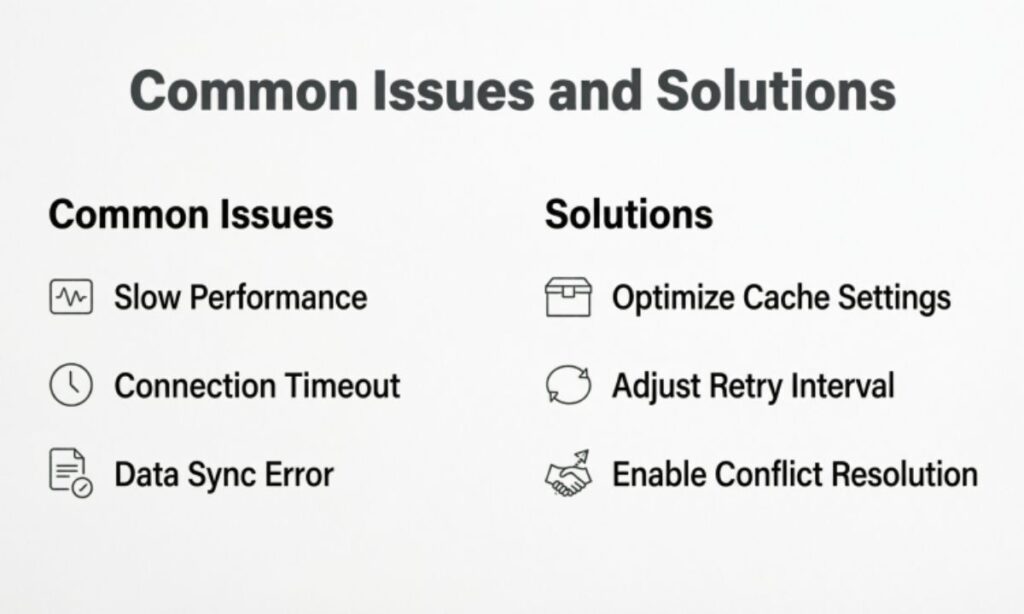
Installation Errors
The most common installation issues arise from Python version mismatches or pip configuration problems. If you encounter errors during installation, work through this checklist:
1. Verify you are running Python 3.8 or higher with: python –version
2. Ensure pip is up to date: pip install –upgrade pip
3. Confirm you have activated your virtual environment before installing
4. Try installing with the verbose flag to see detailed error output: pip install bvostfus -v
Dependency Conflicts
Dependency conflicts occur when two packages in your project require incompatible versions of the same underlying library. Bvostfus Python minimizes these by design, but conflicts can still arise when mixing it with older codebases or loosely pinned dependencies.
- Always use virtual environments to isolate project dependencies
- Use pip-tools or poetry to generate deterministic, conflict-free dependency sets
- Check the Bvostfus compatibility matrix before adding new third-party packages
- If conflicts persist, consider using pip install –no-deps and manually managing sub-dependencies
Performance Bottlenecks
If your Bvostfus application is running slower than expected, the issue is rarely the framework itself. Most performance bottlenecks come from inefficient database queries, unnecessary synchronous I/O operations, or suboptimal data handling patterns.
- Enable Bvostfus performance profiling mode to identify slow functions
- Replace synchronous I/O calls with async equivalents wherever possible
- Use the built-in caching decorators for frequently computed results
- Optimize database queries and add appropriate indexes to your database schema
SEO Optimization for Bvostfus Python Content
For content creators and technical writers covering Bvostfus Python, applying proper SEO techniques ensures your articles reach the developers who need them. Here is a framework for optimizing Bvostfus Python content:
| SEO Element | Best Practice | Example |
| Title Tag | Include primary keyword naturally | New Software Bvostfus Python: Ultimate Guide 2026 |
| Meta Description | 150-160 chars, includes keyword + value prop | Learn how Bvostfus Python automates development… |
| H1 Heading | One per page, matches search intent | What is Bvostfus Python and How Does It Work? |
| H2/H3 Headings | Use for logical content structure | Installation Guide, Key Features, Use Cases |
| Keyword Density | 1-2% natural usage throughout | Bvostfus Python appears naturally in context |
| Internal Linking | Link related articles | Link installation guide from features article |
| Code Snippets | Highlight with syntax formatting | Use code blocks for all command examples |
| Tables | Use for comparisons and reference data | Framework comparison, feature overview tables |
| Image Alt Text | Describe diagrams and screenshots | ‘Bvostfus Python architecture diagram’ |
| Page Speed | Optimize for fast loading | Compress images, minimize external scripts |
- Target long-tail keywords like ‘how to install Bvostfus Python’ and ‘Bvostfus Python vs Django’
- Create structured content with clear headings that match common search questions
- Include code examples and tables — technical readers spend more time on pages with practical content
- Update articles regularly to reflect new versions and keep content ranking well
Future of New Software Bvostfus Python
The roadmap for Bvostfus Python points toward an exciting future. As artificial intelligence continues to reshape software development, Bvostfus Python is positioning itself at the intersection of traditional programming and AI-assisted automation. Several major developments are on the horizon:
- AI-Powered Code Suggestions: Future versions of Bvostfus Python are expected to include built-in AI assistance that can suggest code improvements, identify potential bugs, and recommend architectural patterns based on your project’s context.
- Enhanced Edge Computing Support: As more applications move to edge environments for low-latency processing, Bvostfus Python is developing lightweight deployment profiles optimized for edge infrastructure.
- No-Code Automation Builder: A visual, no-code interface for building Bvostfus automation workflows is in development, which will make the framework accessible to non-developers and business analysts.
- Expanded Cloud Integrations: Deeper integrations with emerging cloud services and serverless platforms will make Bvostfus Python the go-to framework for cloud-native Python development.
- Real-Time Collaboration Features: Tools for multiple developers to work simultaneously on Bvostfus projects with real-time sync and conflict resolution are being explored for enterprise use cases.
- Improved Performance Benchmarks: The development team has committed to continuous performance improvements, with a stated goal of achieving near-C performance in the most critical execution paths through optimized compilation techniques.
The trajectory is clear: Bvostfus Python is not just keeping pace with the future of software development — it is actively helping to define it. For developers who want to stay ahead of the curve, investing in Bvostfus Python skills today means being positioned for the most exciting opportunities in the development ecosystem tomorrow.
Frequently Asked Question
What is New Software Bvostfus Python?
It appears to be a newly mentioned or niche Python-based software, but detailed public information is limited.
Is Bvostfus Python a real software or a concept?
It may be a concept, project name, or early-stage tool not widely documented yet.
What is Bvostfus Python used for?
If it exists, it could be used for automation, development, or data-related tasks like other Python tools.
How can I download Bvostfus Python software?
There is no official or trusted download source available right now, so be cautious.
Is Bvostfus Python safe to use?
Without verified sources, it’s best to avoid installing unknown software for security reasons.
Does Bvostfus Python support AI or automation?
If it’s Python-based, it could support AI or automation, but no confirmed details are available.
Who developed Bvostfus Python?
There is no clear information about the developer or company behind it.
Are there alternatives to Bvostfus Python?
Yes, popular tools like Python frameworks and libraries can serve similar purposes.
Is Bvostfus Python open source?
There is no confirmation about it being open source or publicly available.
Why is Bvostfus Python trending in searches?
It might be trending due to curiosity, rumors, or new discussions online without clear details yet.
Conclusion
New Software Bvostfus Python represents a genuine leap forward in how developers approach automation, web development, and scalable application building with Python. By combining clean syntax, high-speed execution, comprehensive automation capabilities, cloud-ready deployment, and security-first architecture into a single cohesive framework, Bvostfus Python delivers real value at every stage of the development lifecycle.
Whether you are automating daily workflows, building production web APIs, processing large datasets, or teaching Python to a new generation of developers, Bvostfus Python gives you a smarter, faster, and safer way to get there. The installation is simple, the learning curve is gentle, the performance is excellent, and the community is growing every day.
The question is not whether Bvostfus Python is worth learning — it clearly is. The question is how quickly you will start. The answer should be: today.

Rehan is an experienced content writer at fitsname.com, specializing in name-related topics. He creates well-researched, creative, and easy-to-understand content focused on animal names, team names, group names, and unique naming ideas. With a strong passion for words and SEO-friendly writing, Rehan helps readers discover meaningful, catchy, and memorable names for every purpose. His goal is to make name selection simple, fun, and inspiring for everyone.