Music note names are the basic building blocks of music. They help us read, write, and understand songs easily. Every melody and harmony is created using simple note names. Learning these names is the first step for anyone who wants to play an instrument or sing. Without knowing note names, reading music would feel confusing and difficult.
In most Western music, there are seven main note names: A, B, C, D, E, F, and G. After G, the pattern repeats again from A. On a piano, these notes appear on the white keys, while the black keys represent sharp (#) and flat (♭) notes. These sharps and flats change the pitch slightly higher or lower. Understanding this pattern helps musicians play songs correctly and confidently.
Music note names can also be expressed as Do, Re, Mi, Fa, Sol, La, and Ti in the solfège system. This method is often used in singing and music education. Notes are written on a staff made of five lines and four spaces, and each position represents a different pitch. Higher notes sound sharp and bright, while lower notes sound deep and soft. By learning music note names properly, anyone can build a strong foundation in music and enjoy creating beautiful melodies. 🎵
Names of Musical Notes
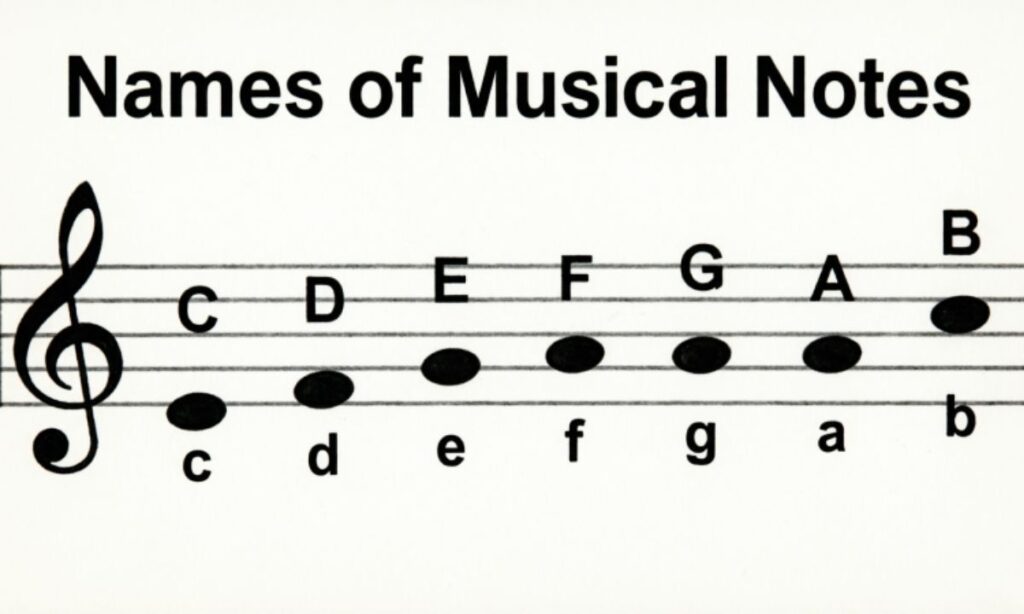
- Foundation of music literacy: Learning note names is the essential first step in reading and understanding music notation
- Universal musical language: These seven letter names (A-G) are recognized worldwide, enabling musicians to communicate across cultures
- Building blocks of melodies: Every song, from simple children’s tunes to complex symphonies, is built from these basic note names
- Applies to all instruments: Whether playing piano, guitar, violin, or singing, these note names remain constant
- Enables music theory understanding: Knowing note names unlocks scales, chords, intervals, and harmonic analysis
- A (La)
- B (Ti/Si)
- C (Do)
- D (Re)
- E (Mi)
- F (Fa)
- G (Sol)
- A♯ / B♭ (A sharp / B flat)
- C♯ / D♭ (C sharp / D flat)
- D♯ / E♭ (D sharp / E flat)
- F♯ / G♭ (F sharp / G flat)
- G♯ / A♭ (G sharp / A flat)
- Middle C (C4)
- Concert A (A4 – 440 Hz)
- Low C (C1)
- High C (C5 or C6 depending on context)
- Tonic (first note of scale)
- Supertonic (second scale degree)
- Mediant (third scale degree)
- Subdominant (fourth scale degree)
- Dominant (fifth scale degree)
- Submediant (sixth scale degree)
- Leading tone (seventh scale degree)
- Octave (same note, higher/lower pitch)
- Unison (same pitch)
Musical Notes and Names
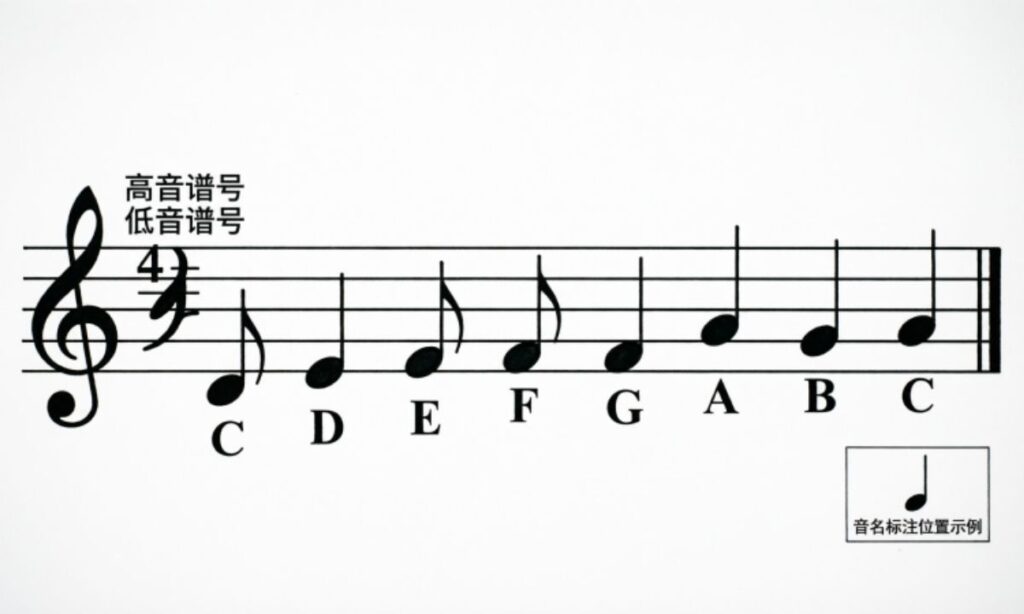
- Solfège system integration: Combines letter names with Do-Re-Mi syllables used for sight-singing and ear training
- International variations: Different countries use various naming conventions (fixed Do vs. moveable Do systems)
- Pitch identification: Note names indicate specific pitches that can be measured in Hertz (vibrations per second)
- Staff notation context: Notes are positioned on lines and spaces of the musical staff to indicate pitch
- Accidentals included: Sharp (♯), flat (♭), and natural (♮) symbols modify basic note names
- Do (C in fixed Do system)
- Re (D in fixed Do system)
- Mi (E in fixed Do system)
- Fa (F in fixed Do system)
- Sol (G in fixed Do system)
- La (A in fixed Do system)
- Ti/Si (B in fixed Do system)
- Ut (archaic name for Do)
- Sa (Indian classical – equivalent to Do)
- Ri/Re (Indian classical – second note)
- Ga (Indian classical – third note)
- Ma (Indian classical – fourth note)
- Pa (Indian classical – fifth note)
- Dha (Indian classical – sixth note)
- Ni (Indian classical – seventh note)
- Treble C (C on treble clef)
- Bass C (C on bass clef)
- Ledger line notes (notes above/below staff)
- Grace notes (ornamental quick notes)
- Passing tones (non-chord tones)
- Neighbor tones (stepwise non-chord tones)
- Pedal tones (sustained bass notes)
- Drone notes (continuous background pitch)
- Root note (foundation of chord)
- Third (interval above root)
Musical Notes and Their Names
- Complete pitch spectrum: Covers all 12 chromatic pitches within an octave plus their enharmonic equivalents
- Enharmonic equivalents: Different note names for the same pitch (e.g., C♯ = D♭)
- Octave registers: Same note names repeat in different octaves (C1, C2, C3, etc.)
- Scientific pitch notation: Uses numbers to indicate specific octaves (middle C = C4)
- Functional harmony names: Describes notes by their role within keys and chord progressions
- C natural
- C sharp (C♯) / D flat (D♭)
- D natural
- D sharp (D♯) / E flat (E♭)
- E natural
- F natural
- F sharp (F♯) / G flat (G♭)
- G natural
- G sharp (G♯) / A flat (A♭)
- A natural
- A sharp (A♯) / B flat (B♭)
- B natural
- Double sharp (𝄪) – raises note two semitones
- Double flat (𝄫) – lowers note two semitones
- C double sharp (C𝄪 = D)
- F double sharp (F𝄪 = G)
- B double sharp (B𝄪 = C♯)
- D double flat (D𝄫 = C)
- E double flat (E𝄫 = D)
- A double flat (A𝄫 = G)
- Octave equivalents (C3, C4, C5)
- Sub-bass notes (C0, C1)
- Soprano range notes (C5-C6)
- Alto range notes (F3-F5)
- Tenor range notes (C3-C5)
Musical Notes with Names
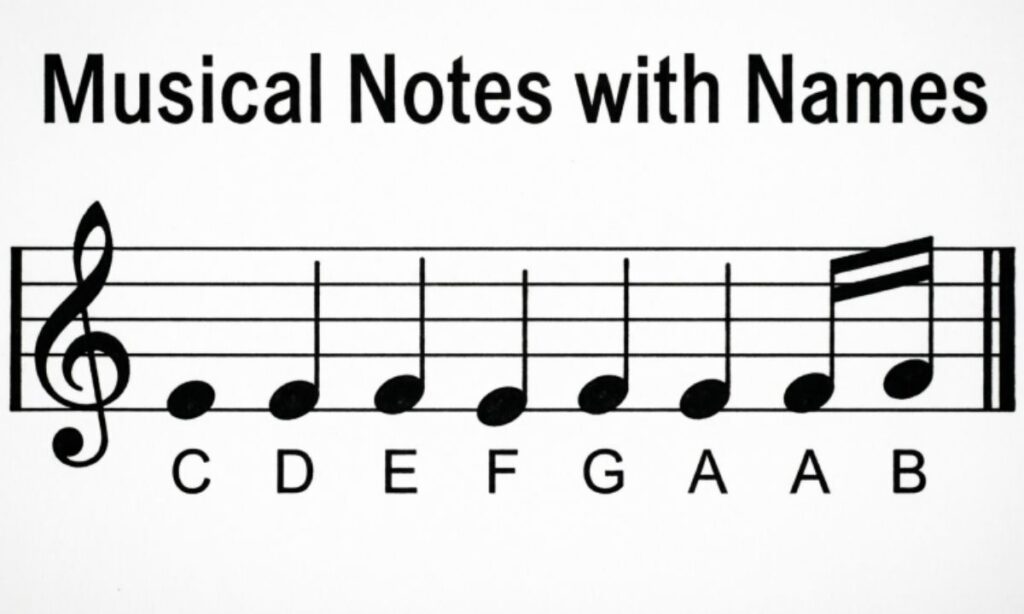
- Visual and verbal identification: Connects the appearance of notes on staff with their letter names
- Clef-dependent reading: Same staff position means different notes in treble vs. bass clef
- Mnemonic devices: Memory aids like “Every Good Boy Does Fine” for treble clef lines
- Interval relationships: Understanding how note names relate to musical distances
- Chord construction: Note names form the basis of chord naming (C major = C-E-G)
- Treble clef G (wraps around second line from bottom)
- Bass clef F (wraps around second line from top)
- Alto clef C (centers on middle line)
- Tenor clef C (centers on fourth line)
- E-G-B-D-F (treble clef lines)
- F-A-C-E (treble clef spaces)
- G-B-D-F-A (bass clef lines)
- A-C-E-G (bass clef spaces)
- Grand staff (treble and bass combined)
- Middle C (between treble and bass staves)
- Ledger line C (middle C with ledger line)
- High A (top space treble clef)
- Low E (bottom line bass clef)
- Stem-up notes (stems go up for lower notes)
- Stem-down notes (stems go down for higher notes)
- Beamed notes (connected eighth notes)
- Dotted notes (extends duration by half)
- Tied notes (connects same pitch across bars)
- Slurred notes (smooth connection, different pitches)
- Staccato notes (short, detached)
- Accented notes (emphasized)
- Fermata notes (held longer)
- Arpeggiated notes (rolled/broken chord)
- Tremolo notes (rapid repetition)
- Trill notes (rapid alternation with upper note)
Note Names & How To Read Them
- Staff reading fundamentals: The five-line staff is the foundation for written music notation
- Clef determines pitch: Different clefs assign different pitches to the same staff positions
- Line and space notes: Notes sit either on lines or in spaces between lines
- Directional reading: Higher on staff = higher pitch; lower on staff = lower pitch
- Key signature context: Sharps or flats at the beginning affect which notes are altered throughout
- First line (E in treble, G in bass)
- Second line (G in treble, B in bass)
- Third line (B in treble, D in bass)
- Fourth line (D in treble, F in bass)
- Fifth line (F in treble, A in bass)
- First space (F in treble, A in bass)
- Second space (A in treble, C in bass)
- Third space (C in treble, E in bass)
- Fourth space (E in treble, G in bass)
- Mnemonic: “Every Good Boy Does Fine” (treble lines)
- Mnemonic: “FACE” (treble spaces)
- Mnemonic: “Good Boys Do Fine Always” (bass lines)
- Mnemonic: “All Cows Eat Grass” (bass spaces)
- Ledger lines above staff
- Ledger lines below staff
- Key signature sharps (F♯-C♯-G♯-D♯-A♯-E♯-B♯)
- Key signature flats (B♭-E♭-A♭-D♭-G♭-C♭-F♭)
- Natural sign cancels sharps/flats
- Accidental applies to whole measure
- Bar line resets accidentals
- Courtesy accidentals (reminder symbols)
- Octave designation numbers
- Helmholtz pitch notation (c, c’, c”, etc.)
- Scientific pitch notation (C4, C5, C6)
- MIDI note numbers (C4 = 60)
Types of Notes – Beats & Length
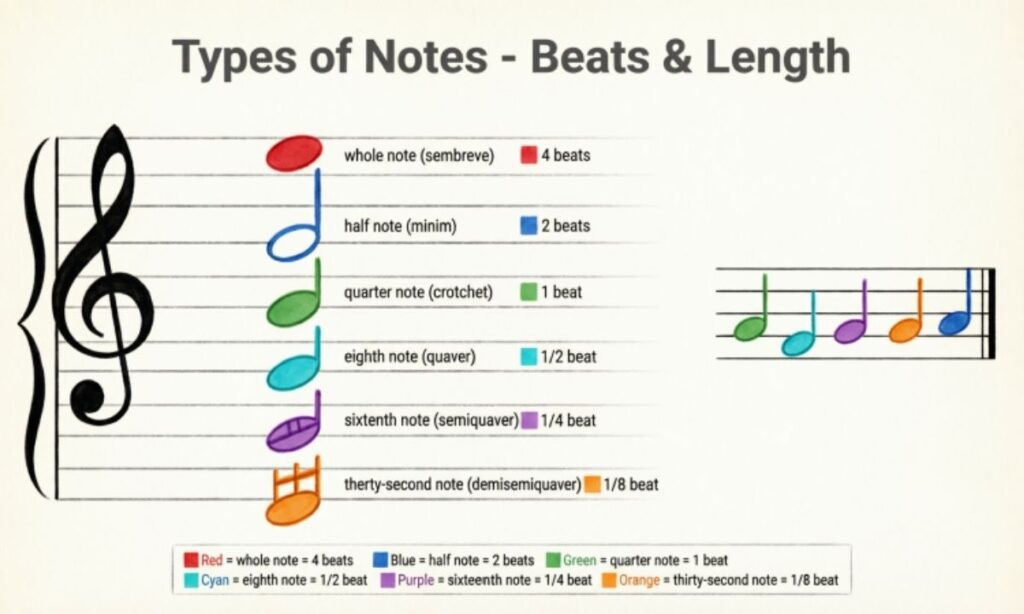
- Rhythmic duration values: Each note type represents specific time duration relative to the beat
- Hierarchical relationships: Each note is twice or half the length of adjacent note values
- Time signature context: The bottom number indicates which note receives one beat
- Rests mirror note values: For every note duration, there’s a corresponding rest symbol
- Mathematical precision: Note durations create exact rhythmic relationships in music
- Whole note (semibreve) – 4 beats in 4/4 time
- Half note (minim) – 2 beats in 4/4 time
- Quarter note (crotchet) – 1 beat in 4/4 time
- Eighth note (quaver) – 1/2 beat in 4/4 time
- Sixteenth note (semiquaver) – 1/4 beat in 4/4 time
- Thirty-second note (demisemiquaver) – 1/8 beat
- Sixty-fourth note (hemidemisemiquaver) – 1/16 beat
- Hundred-twenty-eighth note – 1/32 beat (rare)
- Dotted whole note – 6 beats
- Dotted half note – 3 beats
- Dotted quarter note – 1.5 beats
- Dotted eighth note – 0.75 beats
- Double-dotted notes – adds 3/4 of original value
- Triple-dotted notes – adds 7/8 of original value (rare)
- Whole rest (hangs from line) – entire measure
- Half rest (sits on line) – 2 beats
- Quarter rest – 1 beat
- Eighth rest – 1/2 beat
- Sixteenth rest – 1/4 beat
- Thirty-second rest – 1/8 beat
- Sixty-fourth rest – 1/16 beat
- Breve (double whole note) – 8 beats
- Longa – 16 beats (medieval/renaissance)
- Maxima – 32 beats (medieval)
- Tuplets – irregular note groupings
Piano Keyboard Note Names
- Visual pattern recognition: White and black keys create repeating patterns across the keyboard
- Reference point system: Finding C (or any note) helps locate all other notes
- 88-key standard: Modern pianos have 88 keys spanning 7+ octaves
- White key names: The seven natural notes (A-B-C-D-E-F-G) on white keys
- Black key names: Five chromatic notes with sharp/flat names on black keys
- C (white key left of two black keys)
- D (white key between two black keys)
- E (white key right of two black keys)
- F (white key left of three black keys)
- G (white key second from left in three black group)
- A (white key third in three black group)
- B (white key right of three black keys)
- C♯ / D♭ (first black key in two-key group)
- D♯ / E♭ (second black key in two-key group)
- F♯ / G♭ (first black key in three-key group)
- G♯ / A♭ (second black key in three-key group)
- A♯ / B♭ (third black key in three-key group)
- Middle C (C4 – center of keyboard)
- A0 (lowest note on 88-key piano)
- C8 (highest note on 88-key piano)
- Octave groupings (C1-B1, C2-B2, etc.)
- Low bass register (A0-C2)
- Middle register (C3-C5)
- Treble register (C5-C8)
- Enharmonic black keys (same key, two names)
- White key pattern (W-W-H-W-W-W-H in C major)
- Black key groupings (2-3-2-3 pattern)
- Keyboard topography (physical layout)
- Finger numbers (1=thumb, 5=pinky)
- Hand position reference points
Music Note Names – American and British
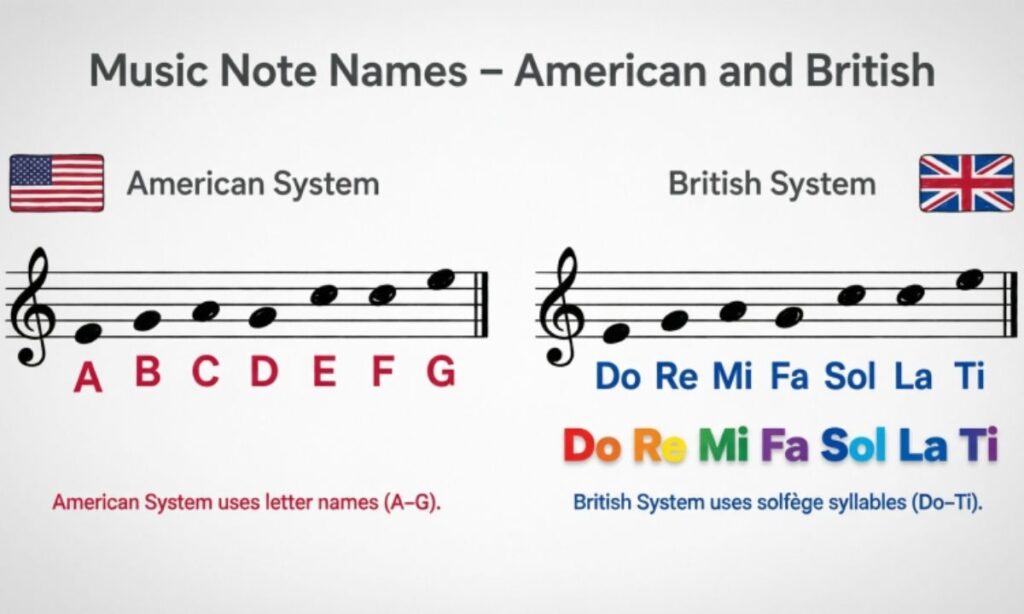
- Transatlantic terminology: Different names for the same note durations between US and UK
- Historical naming origins: British terms often derive from Latin, American terms are more descriptive
- Universal symbols: Despite name differences, the notation symbols are identical worldwide
- Professional standard: Classical musicians often use British terms; American terms common in education
- Duration relationships: Both systems describe the same mathematical relationships between note values
Additional Music Theory Concepts
- Understanding note relationships: Notes function within scales, chords, and harmonic progressions
- Interval naming: The distance between notes has specific names (perfect fifth, major third, etc.)
- Scale degrees: Each note in a scale has a functional name and role
- Chromatic vs. diatonic: Understanding which notes belong to keys versus chromatic alterations
- Enharmonic spelling: Context determines whether to use sharp or flat names for black keys
- Octave equivalence: Notes with the same letter name but different octaves share fundamental properties
- Harmonic series: Natural overtones influence how we perceive and name pitches
- Equal temperament: Modern tuning system divides octaves into 12 equal semitones
- Historical tuning systems: Different eras used various temperaments affecting note relationships
- Reading in different clefs: Same note appears in different positions depending on clef used
Frequently Asked Question
What are music note names?
Music note names are the letters A, B, C, D, E, F, and G used to identify sounds in music.
How many music note names are there?
There are seven basic music note names, and they repeat in the same order.
What are the 7 music note names in order?
The 7 music note names in order are A, B, C, D, E, F, and G.
What are Do Re Mi in music note names?
Do, Re, Mi are part of the solfège system and match C, D, and E in many cases.
How do you read music note names?
You read music note names by looking at their position on the staff lines and spaces.
What are sharp and flat notes?
Sharp (#) makes a note higher, and flat (♭) makes a note lower.
What are piano music note names?
On piano, white keys show A to G, and black keys show sharps and flats.
Why are music note names important?
They help musicians play instruments, read sheet music, and sing correctly.
How do beginners learn music note names?
Beginners practice using charts, piano keys, and simple songs.
Do music note names repeat?
Yes, after G the notes start again from A in a repeating pattern.
Conclusion
Music note names on the staff and piano are the foundation of learning music. They help you understand where each sound belongs and how it should be played. When you connect staff notes to piano keys, everything becomes clearer and easier. With regular practice, reading and playing notes feels natural and smooth.
Learning note names, time values, and symbols builds strong musical skills. It improves your confidence whether you sing or play an instrument. Step by step, you start recognizing patterns without thinking too much. With patience and practice, anyone can master music basics and enjoy creating beautiful melodies.