
Few names in the music industry carry as much weight — and as much controversy — as Marion Hugh ‘Suge’ Knight Jr. Once the undisputed king of West Coast hip-hop, Suge Knight built a label empire that generated hundreds of millions of dollars and launched the careers of some of the most iconic rap artists the world has ever seen. Today, the story looks very different. In 2026, Suge Knight sits in a prison cell, his fortune decimated, his empire long dissolved. But his story remains one of the most fascinating and cautionary tales in entertainment history.
This article covers everything you need to know about Suge Knight’s net worth in 2026 — how much he was worth at his peak, what caused his dramatic financial collapse, and the full story of the man behind Death Row Records. We will walk through his early life, his rise to power, his legal battles, his personal life, and where things stand today.
Suge Knight — Quick Biography at a Glance
| Detail | Information |
| Full Name | Marion Hugh Knight Jr. |
| Nickname | Suge (short for ‘Sugar Bear’) |
| Date of Birth | April 19, 1965 |
| Place of Birth | Compton, California, USA |
| Nationality | American |
| Profession | Record Executive, Music Producer, Entrepreneur |
| Known For | Co-founding Death Row Records (1991) |
| Artists Signed | Dr. Dre, Tupac Shakur, Snoop Dogg, MC Hammer |
| Prison Status | Serving 28-year sentence at Richard J. Donovan Correctional Facility |
| Net Worth (2026) | Estimated $200,000 — $1 million |
| Peak Net Worth | Over $100 million (mid-1990s peak) |
| Death Row Peak Revenue | Over $750 million cumulatively |
Suge Knight Net Worth in 2026
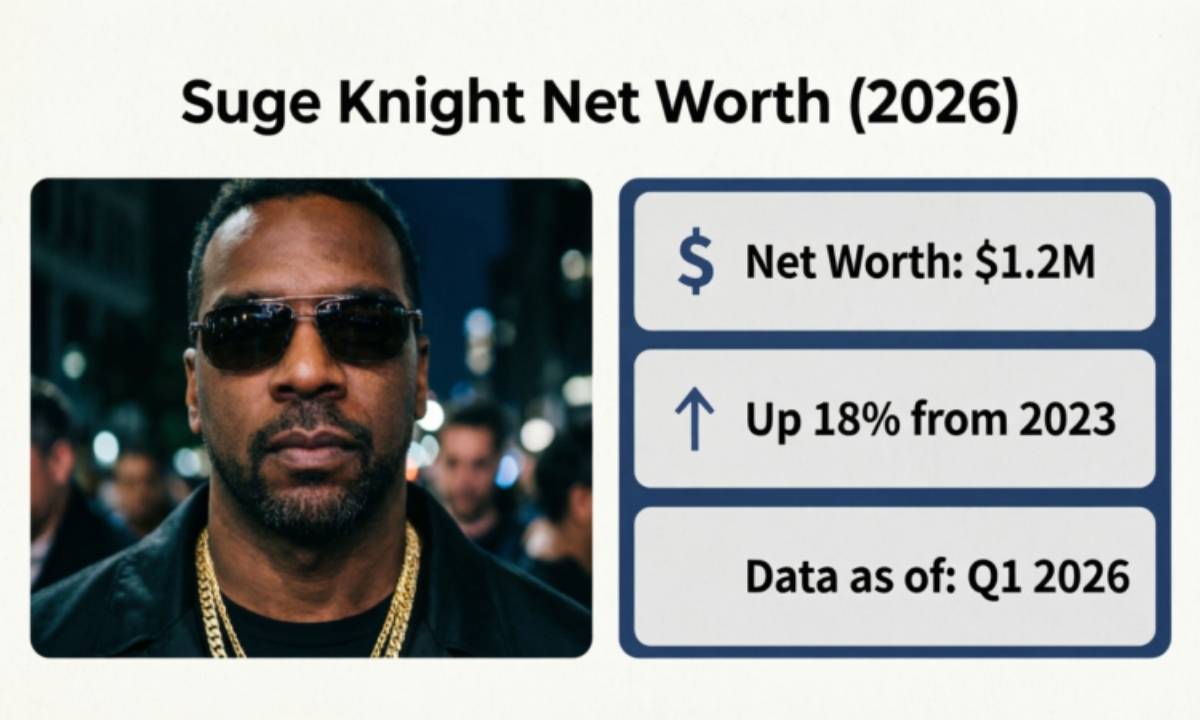
If you search for Suge Knight’s net worth in 2026, you will find a number that seems almost impossible to believe given what he once had. Estimates vary across financial sources, but the most credible assessments place his current net worth somewhere between $200,000 and $1 million. Compare that to the $100 million-plus personal fortune he commanded at his peak in the mid-1990s, and the scale of the collapse becomes staggering.
Some sources place the figure even lower — specifically at around $200,000 — based on his bankruptcy filings, which showed just $11 in a bank account, $25,000 in jewelry, $2,000 in furniture, and $1,000 in clothing. Those numbers are a far cry from a man who once owned fleets of luxury BMWs, operated a Las Vegas nightclub, and controlled the masters of some of the most valuable hip-hop albums ever recorded.
| Time Period | Estimated Net Worth | Key Factor |
| Mid-1990s Peak | $100+ million personal | Death Row generating $100M+ annually at peak |
| Late 1990s Decline | $30–50 million (estimated) | Dr. Dre departure, Tupac murder, label instability |
| 2006 Bankruptcy | Near zero / negative | Federal judge ordered bankruptcy trustee takeover |
| 2008 Label Sale | Minimal personal gain | Death Row Records sold to Global Music Group |
| 2018 — Prison Sentence | Effectively zero | 28-year sentence for voluntary manslaughter |
| 2026 Current Estimate | $200,000 — $1 million | Residual assets, minimal income, ongoing incarceration |
The gap between his peak and current net worth is not just about bad spending — it is the result of serial legal disasters, asset seizures, massive court judgments, bankruptcy mismanagement, and over two decades of ongoing incarceration. This was not a slow decline. It was a collapse that happened in stages, each one more catastrophic than the last.
Early Life and Background
Marion Hugh Knight Jr. was born on April 19, 1965, in Compton, California — one of the toughest neighborhoods in Los Angeles County. He was the youngest of three children raised by Maxine and Marion Knight Sr. His father worked as a janitor and his mother worked on an electronics assembly line. By all accounts, the family was stable and working-class, with his father giving him the affectionate nickname ‘Sugar Bear’ because of his gentle personality as a young child — which is where ‘Suge’ ultimately came from.
That gentle-child nickname would become one of the great ironies of his adult life. Growing up in Compton shaped him in ways that both fueled his ambition and created the aggressive instincts that would eventually destroy everything he built. He attended Lynwood High School, where he excelled in both football and track, quickly establishing himself as one of the better athletes in the region.
Education and Early Athletic Career
- 1983–1985: Attended El Camino College, playing football
- 1985–1987: Transferred to the University of Nevada, Las Vegas (UNLV) on a football scholarship as a defensive end
- 1987: Went undrafted in the NFL Draft but received an invitation to the Los Angeles Rams training camp
- Was cut during training camp but returned as a replacement player during the 1987 NFL Players Strike, playing two games
- After his football career ended, he shifted into concert promotion and worked as a personal bodyguard for celebrities, including R&B star Bobby Brown
Those years as a bodyguard and concert promoter gave Knight a ground-level education in the music business — how events were organized, how artists were managed, how money moved, and who actually held power behind the scenes. It was preparation that would prove invaluable when he made his move into the record industry.
The Rise of Death Row Records
The founding of Death Row Records in 1991 is the central chapter of Suge Knight’s life story. What he built over the following five years was nothing short of extraordinary. Death Row Records did not just succeed — it completely redefined the direction of American hip-hop and popularized an entire genre: West Coast gangsta rap.
The label came together through a combination of business connections, street credibility, and — according to multiple legal documents and testimonies — significant startup capital provided by Michael ‘Harry-O’ Harris, an imprisoned drug lord who invested $1.5 million into the venture through his company, Godfather Entertainment. Knight’s connection to this financing would later become one of the most legally complex elements of his financial story.
Key Artists and Albums That Built the Empire
| Artist | Album | Year | Achievement |
| Dr. Dre | The Chronic | 1992 | Triple Platinum in the US; defined West Coast rap sound |
| Snoop Dogg | Doggystyle | 1993 | Quadruple Platinum; one of best-selling debut rap albums ever |
| Tupac Shakur | All Eyez on Me | 1996 | Double platinum; Tupac’s first Death Row studio album |
| Tupac Shakur | The Don Killuminati: The 7 Day Theory | 1996 | Released posthumously; commercial and critical success |
| Various Artists | Death Row Greatest Hits | 1996 | Compilation that showcased the label’s catalog strength |
| MC Hammer | Various | 1995 | Brief signing; left label shortly after joining |
At its commercial peak in the mid-1990s, Death Row Records was generating over $100 million annually. The label controlled some of the most valuable master recordings in hip-hop history and had a cultural footprint that extended well beyond music into fashion, language, and lifestyle. Suge Knight was not just a label CEO — he was a power broker who shaped the entire industry.
How Suge Knight Made His Fortune
Understanding how Suge Knight accumulated such enormous wealth requires looking at the full range of revenue streams that Death Row Records generated at its height. It was not simply album sales — though those were substantial. The label built a diversified revenue model that was, in many ways, ahead of its time.
- Album Sales and Master Recordings: Death Row controlled the master recordings of some of the highest-selling rap albums of the 1990s. The royalties and licensing fees from those recordings generated income for years after initial release.
- Music Publishing Rights: The label also held publishing rights to many of its artists’ compositions, meaning every time a song was played on radio, licensed for a film, or used in an advertisement, Death Row collected a fee.
- Distribution Deals: Death Row operated through distribution agreements with major labels, receiving advances and ongoing distribution revenue in exchange for catalog access.
- Live Performance Revenue: Knight’s management of major artists gave him a cut of tour income and live performance fees, which were significant for artists of Dr. Dre and Snoop Dogg’s caliber.
- Club 662: Knight owned and operated Club 662, a nightclub in Las Vegas that served as a hub for industry networking and generated direct business revenue.
- Merchandising and Brand Licensing: The Death Row brand — with its distinctive electric chair logo — became a merchandise powerhouse in the mid-1990s, generating income through branded clothing and accessories.
The Fall: How Suge Knight Lost Everything
The collapse of Suge Knight’s financial empire did not happen overnight. It unfolded across a decade of cascading disasters — legal, personal, and professional — each one weakening the foundation further until there was nothing left to stand on. Understanding how it all fell apart is essential to understanding why his current net worth is a fraction of what it once was.
The Departure of Dr. Dre (1996)
The first major crack in the Death Row empire came when Dr. Dre — the label’s founding creative genius and its most commercially valuable artist — decided to leave. Frustrated with the label’s increasingly violent reputation and Knight’s management style, Dre walked away in 1996 to found Aftermath Entertainment. His departure removed the single most important creative and commercial asset from Death Row’s roster.
The Death of Tupac Shakur (1996)
On September 7, 1996, Tupac Shakur was shot four times in a drive-by shooting in Las Vegas while riding in a car with Suge Knight. He died six days later on September 13. Tupac was Death Row’s biggest active artist at the time, and his death created an irreplaceable void in the label’s roster. Knight himself was wounded in the shooting. The murder was never officially solved, and various conspiracy theories — including some implicating Knight himself — have circulated ever since. Suge Knight has never been charged in connection with the killing.
First Imprisonment (1996–2001)
Just months after the Las Vegas shooting, Knight was sent to prison for parole violations stemming from a 1992 assault. His incarceration removed him from the day-to-day operations of Death Row Records at the worst possible moment — just as the label was already destabilized by Dre’s departure and Tupac’s death. Without his direct oversight, the label spiraled.
Bankruptcy (2006)
By 2006, Death Row Records was effectively finished as a functioning business. A federal judge ordered a bankruptcy trustee takeover of the label, citing gross mismanagement. Bankruptcy documents filed during this period revealed the full extent of Knight’s financial devastation — his personal bank account reportedly contained just $11. He had no income from employment or business operations.
Sale of Death Row Records (2008)
In 2008, Knight sold Death Row Records to Global Music Group, a New York-based company, effectively ending his ownership of the label he had co-founded. The label that once generated over $100 million annually was gone. All that remained was the catalog — and Knight no longer controlled even that.
The Fatal Hit-and-Run (2015) and 28-Year Prison Sentence (2018)
The final, decisive blow came on January 29, 2015, when Knight drove his truck into a group of people in a parking lot in Compton, killing one man named Terry Carter and injuring another. Knight claimed the incident was self-defense after an altercation, but prosecutors charged him with murder and hit-and-run. After years of legal proceedings, he pleaded no contest to voluntary manslaughter in 2018 and was sentenced to 28 years in prison. He is currently serving that sentence at the Richard J. Donovan Correctional Facility in San Diego, California.
| Event | Year | Financial Impact |
| Dr. Dre leaves Death Row | 1996 | Lost primary creative and commercial asset |
| Tupac Shakur murdered | 1996 | Lost biggest active artist; label destabilized |
| Suge imprisoned for parole violation | 1996 | Lost direct management of label at critical time |
| Federal judge orders bankruptcy trustee | 2006 | Death Row placed under court-controlled management |
| Death Row Records sold | 2008 | Lost all ownership of label and catalog |
| Hit-and-run incident in Compton | 2015 | Criminal charges, legal fees, asset freezes |
| 28-year prison sentence | 2018 | Complete removal from all income-generating activity |
| Current financial status (2026) | 2026 | Net worth estimated at $200,000 — $1 million |
Personal Life and Family
Behind the fearsome public image and the headline-grabbing controversies, Suge Knight’s personal life has been equally turbulent. His relationships, children, and family dynamics tell a story of a man whose private world mirrored the chaos of his professional one.
Marriages
- First Wife — Sharitha Golden: Sharitha was a rap manager who played a significant role in Knight’s early career development. Their marriage ended in divorce amid legal drama and personal conflict. A restraining order was involved at various points in their troubled relationship.
- Second Wife — Michel’le: Michel’le is an R&B singer who was previously romantically linked to Dr. Dre. She and Knight married in 1999 while he was incarcerated. However, the marriage was later declared legally void because Knight had not properly finalized his divorce from Sharitha Golden at the time of the second ceremony.
Children
Suge Knight is the father of six children:
• Taj Knight — Born 1991 to Davina Barnes; based in Atlanta
• Andrew Knight — Born 1993; based in the Greater Los Angeles area
• Posh Knight — Daughter
• Bailei Knight — Daughter
• Legend Knight — Son
• Sosa Knight — Son
Of his children, Suge Jacob Knight has been the most publicly visible, frequently speaking to media about his father’s health conditions, legal appeals, and ongoing situation in prison. He has also pursued his own career in real estate.
Health in Prison
Knight’s years of incarceration have taken a significant physical toll. Reports from inside the Richard J. Donovan Correctional Facility indicate that he has been dealing with serious health challenges including Type 2 diabetes, blood clot complications, and vision impairment. His son has spoken publicly about concerns regarding his father’s medical care and overall health trajectory while serving such a long sentence.
Suge Knight’s Major Legal Troubles — Complete Timeline
| Year | Legal Issue | Outcome |
| 1987 | Arrested for domestic violence against girlfriend | Processed and released |
| 1987 | Arrested Halloween night in Las Vegas for attempted murder, auto theft, concealed weapon after shooting a man during a carjacking | Pleaded guilty; received two years probation |
| 1992 | Assault charge related to a fight | Led to parole conditions that would later be violated |
| 1995 | Publicly feuded with Sean ‘Puffy’ Combs at the Source Awards, escalating East Coast-West Coast tensions | No legal charge but major industry consequence |
| 1996 | Parole violation — imprisoned after violation stemming from 1992 assault | Served time in prison; Death Row collapsed without him |
| 2001–2003 | Multiple legal battles involving Death Row contracts and lawsuits | Series of costly civil settlements |
| 2006 | Federal judge orders Death Row Records bankruptcy trustee takeover | Lost direct control of Death Row Records entirely |
| 2015 | Fatal hit-and-run in Compton; Terry Carter killed, another man injured | Charged with murder; later reduced |
| 2018 | Pleaded no contest to voluntary manslaughter for the 2015 hit-and-run | Sentenced to 28 years in state prison |
| 2026 | Serving 28-year sentence | Currently incarcerated at Richard J. Donovan Correctional Facility |
Suge Knight’s Legacy and Cultural Impact
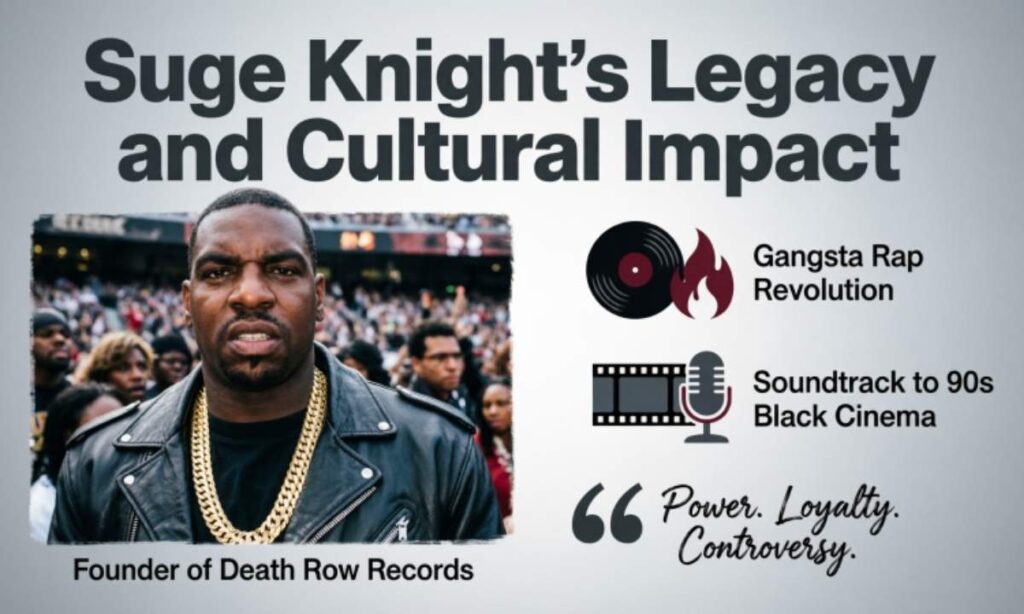
Whatever one thinks of Suge Knight as a person — and there is plenty of room for moral judgment given the facts of his life — his cultural and commercial impact on hip-hop is undeniable. The music that Death Row Records produced in the 1990s did not just sell. It changed the direction of American popular music and helped define an entire decade of cultural expression.
What He Built
- Death Row Records popularized West Coast gangsta rap and shifted the epicenter of hip-hop from New York to Los Angeles in the early-to-mid 1990s
- The Chronic by Dr. Dre (1992) is widely considered one of the most important albums in hip-hop history — it defined the G-funk sound that dominated the decade
- Doggystyle by Snoop Dogg (1993) became one of the fastest-selling debut albums in music history, going quadruple platinum in its first year
- Tupac Shakur’s Death Row-era output, including All Eyez on Me, produced some of his most celebrated and commercially successful work
- Death Row’s business model — combining street credibility with commercial ambition and vertical control of master recordings — influenced how independent hip-hop labels were structured for decades
The East Coast–West Coast Rivalry
One of the most defining and ultimately tragic chapters of Knight’s legacy is his role in escalating the East Coast–West Coast rap rivalry of the 1990s. His public feud with Sean ‘Puff Daddy’ Combs and Bad Boy Records — famously sparked by Knight’s insulting remarks at the Source Awards in August 1995 — helped inflame tensions that contributed to an era of dangerous conflict within the music industry. The deaths of both Tupac Shakur and The Notorious B.I.G. are widely seen as the most devastating consequences of that rivalry, even though Knight was never formally charged in connection with either murder.
What Remains: Suge Knight’s Financial Position Today
In 2026, Suge Knight has almost nothing left in material terms. The label is gone. The cars, the clubs, and the cash are all history. The bankruptcy documents are a matter of public record. The prison sentence is a present reality. But in one sense, something does remain — the catalog.
The Death Row Records music catalog — which includes master recordings by Dr. Dre, Snoop Dogg, and Tupac Shakur — has become extraordinarily valuable in the streaming era. Those recordings generate millions of dollars in streaming royalties, licensing fees, and sync placements every year. However, Knight sold the label and lost ownership of those masters long before their value surged in the digital age. He does not see income from those recordings.
In 2022, Death Row Records was acquired by Snoop Dogg himself — one of its original founding artists. The move was celebrated in the hip-hop community as a kind of homecoming, with an original Death Row artist reclaiming the label’s legacy. For Knight, watching from a prison cell, it was another reminder of how completely the empire he built had passed out of his hands.
| Asset Category | Current Status |
| Death Row Records | Sold (2008); now owned by Snoop Dogg (acquired 2022) |
| Music Masters and Catalog | No longer under Knight’s ownership or control |
| Club 662 Las Vegas | Closed; no longer operating |
| Personal Property | Liquidated during bankruptcy proceedings |
| Bank Accounts | Reported as containing just $11 during bankruptcy filings |
| Real Estate | No known current holdings |
| Income Sources | Effectively none while serving 28-year sentence |
| Children’s Careers | Son Suge Jacob Knight active in real estate |
Frequently Asked Question
What is Suge Knight net worth in 2026?
Suge Knight’s net worth in 2026 is estimated to be very low or negative due to legal issues and loss of assets.
How did Suge Knight make his money?
He made his wealth through music production and co-founding Death Row Records.
Why did Suge Knight lose his fortune?
Legal battles, lawsuits, and prison time caused major financial losses.
Is Suge Knight still earning money in 2026?
No, he has limited or no active income sources due to incarceration.
What was Suge Knight peak net worth?
At his peak, his net worth was estimated around $200 million during the 1990s.
What happened to Death Row Records?
The label declined after legal troubles and was eventually sold and restructured.
Did Suge Knight own luxury assets?
Yes, he owned expensive cars, mansions, and other high-value assets.
Is Suge Knight in prison in 2026?
Yes, he is serving a long prison sentence related to a fatal incident.
Who were the top artists under Death Row Records?
Major artists included Tupac Shakur and Dr. Dre.
What is the real story behind Suge Knight rise and fall?
His rise came from dominating the rap industry, while his fall resulted from violence, legal troubles, and poor decisions.
Conclusion
Suge Knight’s story is a powerful example of how success can rise fast and fall even faster. As the force behind Death Row Records, he helped shape an era of hip-hop and built a huge legacy. His journey shows how big opportunities can change a life, but also how risky decisions can destroy it. In 2026, his net worth clearly reflects the consequences of his past choices and actions.
The life of Suge Knight is a mix of fame, power, and serious mistakes. From working with legends like Tupac Shakur, he reached the peak of the music industry. However, legal troubles and controversies slowly brought everything down. His story is a reminder that long-term success depends on discipline, smart choices, and staying out of trouble.

Rehan is an experienced content writer at fitsname.com, specializing in name-related topics. He creates well-researched, creative, and easy-to-understand content focused on animal names, team names, group names, and unique naming ideas. With a strong passion for words and SEO-friendly writing, Rehan helps readers discover meaningful, catchy, and memorable names for every purpose. His goal is to make name selection simple, fun, and inspiring for everyone.