
What does MH mean in text messages? Many people see this short term in chats and social media but feel confused. MH is a modern slang that can change meaning based on context. It is often used in casual conversations between friends. Understanding it helps you read messages more clearly.
In most cases, MH is used to express emotions or mental state in a short way. People may use it when talking about mood, feelings, or thoughts. The meaning can differ depending on the conversation. That is why context is very important. Learning slang like MH makes texting easier and faster.
In 2026, texting language continues to grow with new short forms like MH. Social media platforms play a big role in spreading these terms. Young users often create and use such abbreviations daily. Knowing their meanings helps you stay updated online. This guide will help you understand MH in a simple way.
What Does MH Mean in Text? (Quick Definition)
If someone sends you MH in a text message, a DM, or a comment and you are not sure what it means, you are in good company. MH is one of those quiet but powerful pieces of digital shorthand that has become deeply embedded in how emotionally expressive people communicate online — yet it never seems to get the attention that louder abbreviations like LOL or OMG receive.
At its most common and most important level, MH means My Heart. It is a compact way of expressing that someone has touched your emotions, that you feel deep affection or care for them, or that something they have said or done has moved you in a meaningful way. When your best friend messages you at midnight to say they are struggling and you respond with MH, you are not just acknowledging the message — you are communicating warmth, solidarity, and care in two letters.
MH carries a second distinct and increasingly important meaning: Mental Health. In conversations about emotional wellbeing, self-care, and psychological struggles — particularly on platforms like TikTok and Instagram where mental health awareness content has exploded in recent years — MH operates as shorthand for the entire concept of mental health. Someone might write checking in on ur MH or MH matters more than anything, and in both cases the meaning is unmistakable.
The two meanings of MH occupy different emotional registers but share a common thread: both are about emotional depth and human wellbeing. Understanding which meaning applies in any given message is almost always straightforward from context, and this guide covers both fully.
Why MH Became So Popular in Texting
The rise of MH as everyday digital shorthand reflects something genuinely interesting about how younger generations communicate emotion in text-based environments. Emotional expression through text has always faced a fundamental challenge: writing lacks the vocal tone, facial expression, and physical presence that carry so much of emotional communication in person. Internet slang, emojis, and abbreviations like MH are the informal solutions that digital communicators have developed to bridge this gap.
MH became popular for several converging reasons. First, the phrase my heart is already a culturally resonant emotional expression in English — people say you give me heart eyes, you stole my heart, my heart is full — so abbreviating it to MH preserves the emotional weight while fitting the fast-paced rhythm of digital messaging. Second, the rise of mental health awareness culture, particularly among Gen Z, made MH as mental health shorthand feel natural and even necessary in a generation that talks about psychological wellbeing as casually as previous generations discussed physical health.
Third, and perhaps most importantly, MH fills an emotional gap that other abbreviations leave open. ILY (I love you) is strong and declarative. HMU (hit me up) is logistical. MH occupies the tender middle ground of emotional expression that is not quite I love you but is significantly warmer than standard acknowledgment. That specific emotional register — deep care without the full weight of a love declaration — is exactly what many digital conversations need.
- MH bridges the gap between casual acknowledgment and full emotional declaration in digital communication
- The phrase my heart is already culturally established — MH abbreviates an existing emotional expression
- Mental health as a cultural conversation topic among Gen Z made MH in that sense feel natural
- Two-character abbreviations fit perfectly in fast-scrolling, high-volume digital messaging environments
- MH works across all major messaging platforms without platform-specific constraints
- Its emotional warmth makes it useful in situations where longer expressions feel too heavy or too slow
Emotional Meaning Behind MH (This Is Important)
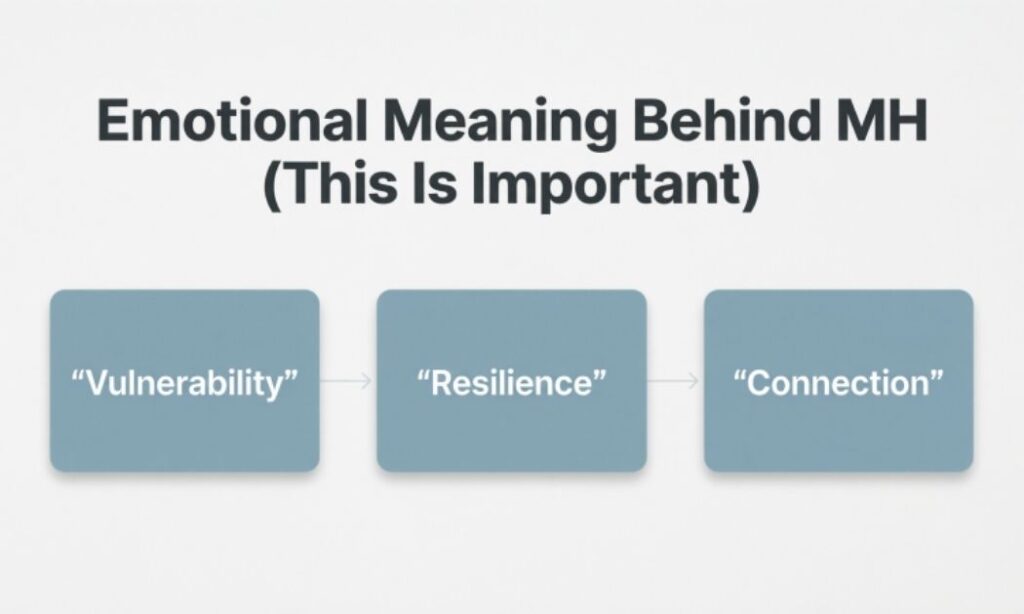
Of all the things this guide covers, the emotional meaning behind MH is the most important to understand fully. Because MH is not just a convenient shortcut — it is an emotional signal. When someone sends MH to you, they are communicating something about how they feel, not just updating you on a fact or confirming a plan.
When used to mean My Heart, MH communicates a range that spans genuine empathy, romantic affection, deep friendship appreciation, and moments of being emotionally moved. The specific emotional content depends on the relationship and the conversation, but the baseline message is always the same: you matter to me, and I feel something meaningful right now in connection to you or what you have said.
This emotional specificity is what makes MH more interesting than purely logistical abbreviations. When someone types MH in response to you sharing something vulnerable or beautiful or funny, they are choosing an emotional response over a neutral one. They are signaling that they were genuinely affected, not just processing information.
| Emotional Register | What MH Communicates | Typical Scenario |
| Deep empathy | I feel this with you; you are not alone | Friend shares a painful experience |
| Romantic affection | You make my heart feel full | Partner says something unexpectedly sweet |
| Tender friendship | You mean so much to me | Best friend does something thoughtful |
| Being emotionally moved | This touched me deeply | Someone shares beautiful news or art |
| Protective care | I want to shield you from pain | Someone you love is going through hard times |
| Gratitude with emotion | This means more than words | Someone goes above and beyond for you |
| Mental health check-in | I am thinking about your wellbeing | Checking on someone who has been struggling |
Real Chat Examples (How People Actually Use MH)
Reading about slang is useful, but seeing it in realistic conversation is where understanding actually clicks. The following examples reflect how MH genuinely appears in everyday digital communication — not perfectly constructed sentences, but the kind of real, flowing conversation that happens between actual people.
Example 1: Casual Care
Maya: I’ve been so stressed lately, I don’t even know where to start
Jordan: MH, I’m here if you want to talk it through
Maya: you always know what to say
Jordan: MH always, you matter
In this exchange, Jordan uses MH twice — both times as an expression of empathetic warmth rather than a declaration of romantic love. The MH signals genuine care without overcomplicating the emotional register of a supportive conversation between close friends.
Example 2: Emotional Support
Alex: I just got rejected from the program I really wanted
Sam: oh no MH I’m so sorry, you worked so hard
Alex: it hurts more than I expected
Sam: I know. MH. Take all the time you need, I’m not going anywhere
Here MH functions as an emotional hug delivered through text — a way of communicating physical-world warmth (the kind that would show up as an actual hug or a hand on someone’s shoulder in person) through the necessarily flat medium of written digital communication.
Example 3: Romantic Tone
Dev: woke up thinking about you for no reason
Priya: MH stop it
Dev: MH you first
This playful exchange uses MH in a fully romantic context where both people are signaling affection while keeping the tone light. The MH you first response particularly shows how the term can carry humor and flirtation simultaneously.
Example 4: Friendship Bond
Kira: you’ve been there for me through so much this year
Lena: as if I’d be anywhere else, MH you’re my person
Kira: MH literally what would I do without you
This exchange demonstrates how MH functions at the deep end of friendship communication — expressing a bond that is genuine and lasting but not romantic. The term my person combined with MH creates an emotional atmosphere that is entirely about chosen family rather than romance.
MH in Different Contexts (Context Changes Everything)
The meaning and emotional weight of MH shifts depending on the context in which it appears. The same two letters can signal very different things depending on who is sending them, what platform the conversation is happening on, and what the broader social relationship is between the people involved.
1. Social Media Usage
On platforms like TikTok and Instagram, MH operates in a more public and performance-oriented way than it does in private messaging. In the comments section of an emotionally resonant video, MH functions as a form of emotional solidarity — a way of signaling to the creator and to other viewers that you were genuinely moved. It is a form of digital empathy expressed at scale.
On social media, MH as mental health is also extremely common. Mental health awareness content on TikTok and Instagram has created a vocabulary of care around the abbreviation, where creators and their communities use MH as shorthand for a conversation topic that is both personally meaningful and socially important.
2. Romantic Relationships
In the context of romantic relationships, MH operates at its most emotionally loaded. Between partners, MH carries the warmth of deep affection and the intimacy of private emotional language. Couples often develop shorthand that carries meaning specific to their relationship, and MH frequently becomes part of that intimate vocabulary — a way of saying something meaningful quickly, during busy days, in the gaps between longer conversations.
3. Friendships
Among close friends, MH sits at the emotional center of many supportive exchanges. It is the two-letter version of the kind of warmth that close friendships are built on — the consistent, reliable signal that someone cares about your wellbeing and is emotionally present in your life. In this context MH requires no declaration or explanation; it is simply understood as a marker of genuine care between people who have built enough relational history that the abbreviation carries its full weight automatically.
4. Professional Settings
MH has no appropriate place in professional communication. In a work email, a formal message to a colleague, or any institutional communication, MH would be inappropriate regardless of which meaning is intended. If the intent is mental health, writing the full term is both clearer and more respectful of the seriousness of the topic. If the intent is My Heart, that level of personal emotional expression is simply not appropriate in professional contexts.
| Context | MH Meaning Used | Appropriate? | Tone |
| Close friend DM | My Heart — empathy and care | Yes — ideal | Warm, personal, emotionally present |
| Romantic partner message | My Heart — affection | Yes — natural | Tender, intimate, loving |
| Instagram/TikTok comment | My Heart or Mental Health | Yes — standard | Public empathy, social solidarity |
| Group chat with close friends | My Heart — belonging | Yes — natural | Fun, warm, inclusive |
| Work email or Slack | Either meaning | No — inappropriate | Would seem unprofessional |
| First message to someone new | My Heart | Caution — may seem intense | Could feel presumptuous early on |
| Mental health support content | Mental Health | Yes — important context | Caring, aware, supportive |
MH vs Similar Slang (Important Comparison)
| Term | Meaning | Emotional Weight | vs MH |
| MH | My Heart / Mental Health | Deep but flexible | Baseline for this comparison |
| ILY | I Love You | Very high — full declaration | Heavier and more committed than MH |
| ML | My Love | High — term of endearment | Slightly more romantic than MH |
| MY | Miss You | Moderate — longing | Specific to absence; MH is broader |
| HM | Hmm — thinking/doubt | Low — conversational | Completely different — don’t confuse these |
| MHM | Mmm-hmm — agreement | Low — acknowledgment | MHM is sound-based; MH is emotional |
| <3 | Heart emoji text | High — visual warmth | Both express heart; <3 is more universal |
| ILY2 | I Love You Too | Very high | Response to love; MH is more standalone |
| SMH | Shaking My Head | Negative — disappointment | Completely different; do not confuse |
Common Variations of MH You Will See
Like most internet slang, MH does not exist in isolation. It appears in a range of variations and combinations that extend its expressive range and allow it to fit different emotional contexts with more precision.
Popular Variations
- MH always — a permanent declaration of ongoing care, not tied to a single moment
- MH so much — an intensified version that signals the emotion is particularly strong right now
- MH fr — combining with fr (for real) to signal that the emotion is genuine, not performative
- MH ngl — pairing with ngl (not gonna lie) to add a layer of vulnerability and honesty
- big MH — informal intensifier emphasizing that the emotional response is significant
- MH moment — describing a situation or experience that moved you emotionally
- sending MH — a caring sign-off or check-in, similar to sending love but slightly less intense
- ur literally my MH — using MH as a noun to describe what someone is to you
- MH check — specifically asking about or offering a mental health check-in
- MH vibes — describing an emotionally warm and supportive atmosphere
How to Respond to MH Naturally
Receiving MH and not knowing how to respond naturally is more common than you might think. The emotional register of MH is specific enough that a purely logistical reply can feel cold, but a dramatically emotional reply can feel disproportionate. Here are options organized by tone to help you find the response that fits your relationship and the moment.
Casual Replies
* MH back at you, always
* Stop, you’re going to make me feel things
* You’re my MH too, you know that
* Okay but same though
* This made my whole day, thank you
* MH fr, you mean so much
Romantic Replies
* MH you’re literally everything
* And you’re mine, always
* Okay stop I’m smiling at my phone again
* You have no idea what you do to my actual heart
* MH so much it’s embarrassing honestly
* Why are you so perfect, MH
Friendly Replies
* MH you’re literally the best person
* Okay I genuinely needed to hear that today
* MH right back, you’re my person
* Stop being so sweet I can’t handle it
* This is why I keep you around, MH
* You make everything better just by existing
Funny Replies
* MH but also please stop being cute it’s stressful
* My heart AND my brain, you’re taking everything
* MH except when you eat my leftovers
* Okay but same yet I would never admit that
* Sending MH right back before I say something embarrassing
* MH but don’t let it go to your head
Is MH Rude or Offensive?
The straightforward answer is no — MH is one of the warmest and most universally positive pieces of internet slang in common use. Neither My Heart nor Mental Health carries any negative connotation, and the term has no documented history of being used as an insult, a put-down, or an offensive signal in any cultural context.
The only situation where MH might create discomfort is one of mismatched emotional expectations rather than any rudeness in the term itself. If someone sends MH in a context where the recipient interprets it as more romantic than was intended, or as less serious than the emotional content of the conversation warranted, the disconnect can feel awkward. But this is a communication calibration issue, not a problem with the term.
One potential area of sensitivity is the mental health meaning. Because mental health is a serious topic that involves real suffering for many people, using MH as a flippant shorthand in contexts where someone is genuinely struggling can feel minimizing if not accompanied by genuine engagement with what the person is experiencing. Using MH as a check-in or expression of care in these contexts is appropriate and warm; using it as a superficial acknowledgment that you have registered someone’s mental health mention without actually engaging is where the term can feel insufficient.
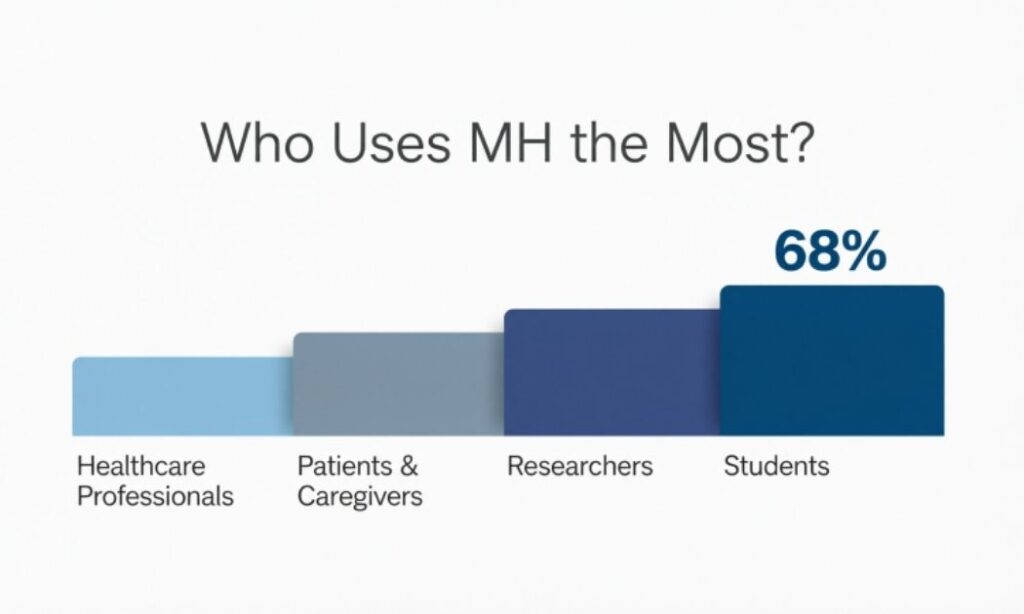
Who Uses MH the Most?
Age Group
MH is most heavily used by Gen Z — people currently aged approximately 13 to 28 — with the highest concentration of usage in the 16 to 24 range. This demographic grew up with smartphones as their primary communication device and developed fluency in digital emotional shorthand as naturally as previous generations developed fluency in face-to-face social cues. Millennials in their late twenties and early thirties use MH with some frequency, particularly in the mental health context, but with less automatic fluency than their younger counterparts.
Platforms
The heaviest usage of MH is concentrated on WhatsApp and iMessage in direct messaging contexts, where personal emotional communication is most natural. Instagram DMs and comment sections are the next most significant environment. TikTok is where the mental health meaning of MH has its strongest presence, reflecting the platform’s role as the primary space where Gen Z mental health discourse happens in real time. Snapchat sees MH in personal message threads between close contacts.
Regions
MH as internet slang is primarily an English-language phenomenon with its heaviest usage in the United States, United Kingdom, Canada, Australia, and increasingly in South Asian countries including India and Pakistan, where English-language digital communication among younger generations has absorbed Western internet slang vocabulary rapidly. The mental health meaning of MH has a particularly strong foothold in markets where Western mental health awareness conversations have been influential, including the UK and much of urban South Asia.
Origin of GNG: Where Did It Come From?
The origin of MH as digital shorthand has two distinct tracks that developed somewhat independently before converging in mainstream youth culture. Understanding each origin separately helps explain why the term carries such different meanings in different communities.
The My Heart meaning of MH evolved organically from the general culture of abbreviating emotional phrases in text communication. Expressions like my heart, you have my heart, and my heart goes out to you are longstanding emotional idioms in English, and their abbreviation to MH followed the same pattern that turned be right back into BRB and I love you into ILY. This evolution accelerated as emoji culture developed alongside text shorthand — while heart emojis provided one channel for visual emotional expression, MH developed as the text-only equivalent for people who preferred typed words over symbols.
The Mental Health meaning has a different and more historically specific origin. The global cultural conversation about mental health began shifting dramatically in the 2010s as public figures started speaking openly about psychological struggles, and platforms like Tumblr, then Twitter, then TikTok became spaces where mental health discussion was normalized rather than stigmatized. As these conversations became more frequent and more casual, the need for efficient shorthand grew and MH as an abbreviation for mental health became established terminology within communities built around those conversations.
| Period | Development in MH History |
| Early 2000s | SMS culture develops abbreviation conventions; emotional phrases begin shortening |
| 2010 to 2013 | Social media platforms create more emotional sharing; heart-related expressions grow |
| 2013 to 2016 | Tumblr and Twitter normalize mental health discussion; MH as shorthand emerges |
| 2016 to 2019 | Instagram DMs and Snapchat make MH as My Heart widespread in personal messaging |
| 2019 to 2021 | TikTok becomes primary mental health conversation platform; MH as Mental Health peaks |
| 2021 to 2023 | Both meanings coexist stably; context determines interpretation universally |
| 2024 to 2026 | MH fully established in Gen Z vocabulary; growing adoption in Millennial usage |
Cultural Differences in MH Usage
Western Culture
In Western digital culture — particularly in the United States, United Kingdom, and Canada — MH as My Heart is used freely in both friendships and romantic relationships without the cultural taboo that might attach to direct emotional declarations in some other contexts. The emotional directness that characterizes American digital communication in particular makes MH a natural fit, since it allows for genuine emotional expression without the full weight of a verbal declaration.
The mental health meaning of MH is also most established in Western contexts, where the cultural normalization of mental health conversation has progressed the furthest and where the abbreviation feels both natural and socially appropriate. Mental health awareness campaigns, celebrity disclosures, and the general wellness culture of Western social media have all reinforced MH as a recognized and respected shorthand.
Asian Culture
In South Asian digital culture — particularly in India and Pakistan, where English-language social media use among younger generations is extremely high — MH has been adopted with enthusiasm, particularly in its My Heart form. The warmth that MH expresses aligns well with the deep relational bonds and emotional expressiveness that characterize many South Asian friendships and family relationships, even in digital communication contexts.
In East Asian digital cultures where English-language social media is less dominant, MH is less universally recognized, though it appears in communities that are heavily plugged into English-language digital culture. The mental health meaning of MH is growing in adoption across South Asian contexts as mental health awareness conversations gain traction.
Middle Eastern Culture
In Arabic and Persian-speaking communities that use English-language social media, MH in its My Heart form has found a receptive audience partly because the heart as a symbol of deep affection is a cultural touchstone across Middle Eastern languages and traditions. The warmth and care that MH expresses resonates across cultural boundaries. However, the mental health meaning of MH is less established in these communities, where mental health as an open conversation topic is still at an earlier stage of normalization than in Western contexts.
Personality Traits of People Who Use MH
No abbreviation perfectly predicts personality, but patterns in who uses MH and how they use it do reveal something about the people drawn to this particular form of emotional expression in digital communication.
- Emotionally intelligent — people who use MH regularly are typically comfortable with emotional expression and aware of others’ feelings
- Empathetic communicators — they respond to emotional content in conversations rather than deflecting or minimizing it
- Relationship-oriented — MH users tend to prioritize the quality of their connections over transactional communication
- Genuine and direct — the willingness to use an emotional abbreviation without irony suggests comfort with authentic expression
- Socially aware — particularly true of people who use MH in its mental health sense; they tend to be plugged into conversations about wellbeing and psychological health
- Digitally fluent — comfortable using the specific vocabulary of their platform and generational community
- Consistent — people who use MH tend to use it regularly rather than occasionally; it is part of their communication style rather than a borrowed affectation
When You Should NOT Use MH
- In professional emails, work messages, or any institutional communication where casual slang is inappropriate
- In the first few messages to someone you do not know well — it can feel presumptuous or overly intimate before a relationship is established
- When the conversation calls for more substantive emotional engagement — sending MH and nothing else in response to someone sharing a serious mental health struggle can feel like a dismissal rather than care
- In contexts where the My Heart and Mental Health meanings could create genuine confusion
- In public posts or formal writing where your communication will be read by a broad, mixed-age, mixed-culture audience
- When the person you are communicating with has indicated they prefer plain language or is not familiar with internet shorthand
- In sensitive conversations where ambiguity between the two meanings of MH could be hurtful or misleading
MH Meaning vs Mental Health (Important Distinction)
The coexistence of two meanings within the same abbreviation creates an important practical consideration for anyone using MH in conversations where both could theoretically apply. In most cases, context resolves the ambiguity completely and naturally — a conversation about someone’s emotional struggles will read MH as mental health, while a conversation with a romantic partner will read MH as My Heart, and neither requires explanation.
However, there are edge cases where the meanings could blur in potentially uncomfortable ways. If you send someone MH in the middle of a conversation about their mental health struggles and they interpret it as a romantic signal, that is an awkward miscommunication. The reverse — someone intending MH as an affectionate My Heart and being read as commenting on mental health — is less likely to cause harm but might still land oddly.
The practical solution is simple: when you are in a context where the mental health meaning is genuinely relevant and serious, consider writing the full phrase rather than the abbreviation, particularly if the conversation is emotionally significant. Abbreviations serve efficiency; in moments that require full care and presence, full words serve the relationship better.
Search Intent Breakdown (Topical Gap Covered)
1. Informational Intent
Most people who search for MH meaning in text are looking for a clear, straightforward definition — they received MH in a message and want to understand what it meant. This is informational intent, and the answer is direct: most likely My Heart, possibly Mental Health, determined by context. This guide addresses that need fully and immediately rather than burying the answer in extensive background.
2. Emotional Intent
A smaller but significant group of searchers are looking for validation of an emotional experience — they sent or received MH and want to understand the emotional dimensions of what was communicated. Was it romantic? Was it just friendly? Does it mean what they hope it means? These questions are addressed throughout this guide in the sections on emotional meaning, context, and real chat examples.
3. Conversational Intent
Some readers want to use MH themselves but want to make sure they are using it correctly and naturally before doing so. The sections on how to reply, variations, when to use it, and real examples are designed specifically to serve this intent — giving readers the confidence to incorporate MH into their own digital communication authentically.
| Search Intent | What the Reader Wants | Where This Guide Addresses It |
| Informational | Clear definition of MH | Quick Definition and Quick Reference sections |
| Emotional | Understanding what it meant in their specific message | Emotional Meaning and Real Examples sections |
| Conversational | How to use MH naturally themselves | Variations, Replies, and When to Use sections |
| Comparative | How MH differs from similar terms | MH vs Similar Slang and Cultural Differences sections |
| Cautionary | Whether MH is appropriate in their situation | Formal vs Informal and When NOT to Use sections |
MH vs Other Emotional Slang (Topical Gap Covered)
MH vs ML vs MY vs HM
These four two-letter abbreviations are closely enough related that they cause confusion, and distinguishing them clearly adds real value for anyone navigating digital communication.
| Term | Full Meaning | Emotional Register | Typical Use |
| MH | My Heart / Mental Health | Deep affection or wellbeing concern | Emotional support, care, romantic warmth |
| ML | My Love | Direct romantic endearment | Romantic partners; more committed than MH |
| MY | Miss You | Longing for absent person | When separated from someone you care about |
| HM | Hmm (thinking sound) | Neutral — processing or uncertainty | Conversational pause; NOT emotional |
| MHM | Mmm-hmm (verbal agreement) | Low — passive affirmation | Agreeing without strong engagement |
The most important practical distinction is between MH and HM — two abbreviations that look like transpositions of each other but carry completely opposite emotional registers. MH is warm and affectionate; HM suggests hesitation, doubt, or neutral processing. Confusing these two in a message would produce meaningfully different impressions, so it is worth being careful with which you type.
The Real Meaning of MH (Human Insight)
After covering every technical, contextual, and cultural angle of MH, it is worth stepping back and asking what the term actually reveals about the people who use it and the way digital communication is evolving.
The fact that My Heart has become an established piece of digital shorthand says something genuine and moving about what people need from text-based communication: they need ways to express warmth, care, and emotional presence that are fast enough for the rhythm of digital conversation but meaningful enough to actually convey something real. MH solves that problem elegantly. It is quick to type, universally understandable in context, and carries a warmth that purely logistical communication entirely lacks.
The dual meaning with Mental Health says something equally important: that the generation currently building the vocabulary of digital communication takes psychological wellbeing seriously enough to give it its own shorthand. When a generation develops abbreviations for its most important concerns, those abbreviations tell you what that generation considers worth naming quickly — and the naming of mental health in two letters alongside the naming of heart care is, when you think about it, a genuinely hopeful sign about where cultural values are heading.
MH is a small thing — two letters, a fraction of a second to type, easy to overlook in the flow of a conversation. But like all good language, it carries more than it appears to. It carries care, and presence, and the specifically human desire to let the people we love know that we are here, that we feel what they feel, that their wellbeing matters to us. In a world where communication has never been faster or more abundant, that signal — delivered in two quiet letters — still means something. Maybe it means everything.
Frequently Asked Question
What Does MH Mean in Text Messages?
MH is often used to express “mental health” or a person’s emotional state in chats.
What Does MH Stand for in Slang?
In slang, MH usually refers to mood, feelings, or mental condition in a short form.
Is MH Related to Mental Health?
Yes, MH is commonly linked with mental health discussions in texting and online posts.
How Do You Use MH in a Sentence?
You can say, “How’s your MH today?” to ask about someone’s emotional well-being.
What Does MH Mean on Social Media?
On social media, MH is used to talk about emotions, stress, or personal mental state.
Is MH a Positive or Negative Term?
MH is neutral and depends on context, often used for supportive or emotional talks.
What Does MH Mean in Instagram Chats?
On Instagram, MH is used in DMs or captions to express feelings or mental state.
Can MH Mean Something Different?
Yes, MH can have different meanings, but most commonly it refers to mental health.
Who Uses MH Most in Texting?
Teenagers and young adults mostly use MH when discussing emotions or personal feelings.
Why Do People Use MH in Messages?
People use MH to quickly express emotions or talk about mental well-being in short form.
Conclusion
MH in text usually refers to mental health or a person’s emotional state. It is often used in chats to talk about feelings, mood, or well-being. The meaning depends on the context of the conversation. It is a simple way to express emotions quickly in messages.
Understanding MH helps you communicate better in modern texting and social media. It is commonly used when people want to check on someone’s feelings or mental condition. Using it correctly makes your conversations more natural and clear. In 2026, slang like MH is becoming more common in daily online talk.

Rehan is an experienced content writer at fitsname.com, specializing in name-related topics. He creates well-researched, creative, and easy-to-understand content focused on animal names, team names, group names, and unique naming ideas. With a strong passion for words and SEO-friendly writing, Rehan helps readers discover meaningful, catchy, and memorable names for every purpose. His goal is to make name selection simple, fun, and inspiring for everyone.