
FRL is a modern slang word often seen in text messages and social media. It usually stands for “For Real Like” and is used to show honesty or agreement in a casual way. People use it to sound more natural in everyday conversations. It is short, simple, and easy to type quickly. Understanding FRL helps you stay updated with current texting trends.
In most cases, FRL is used when someone wants to be genuine or express real feelings. It can also confirm that something is true or serious. You may see it in chats, comments, or captions across different platforms. Its meaning can slightly change depending on the situation. Still, it always keeps a friendly and informal tone.
Slang like FRL keeps evolving with internet culture and online communication. New words appear as people look for faster ways to express themselves. Learning these terms makes chatting easier and more engaging. FRL is just one example of how language is changing online. This guide will help you understand and use it correctly.
What Does FRL Mean in Text? (Quick Answer)
Quick Answer
FRL stands for “For Real” — used to express sincerity, confirm something is true, emphasize a point, or add genuine weight to a statement in casual digital communication.
At its most basic level, FRL is simply the abbreviated form of the phrase “for real.” It appears at the beginning, middle, or end of a text message to signal that the speaker is being completely serious and honest about what they are saying. It functions as a sincerity marker — a small but powerful signal that what follows or what just came before is not a joke, not an exaggeration, and not something to be taken lightly.
The beauty of FRL is in its versatility. It can intensify a compliment, validate a friend’s experience, express genuine shock or disbelief, confirm a fact, or simply add emotional weight to a statement that might otherwise read as flat in text form. Three letters do a lot of communicative work, which is exactly why the expression has embedded itself so deeply in everyday digital language.
Understanding FRL in Modern Texting Culture
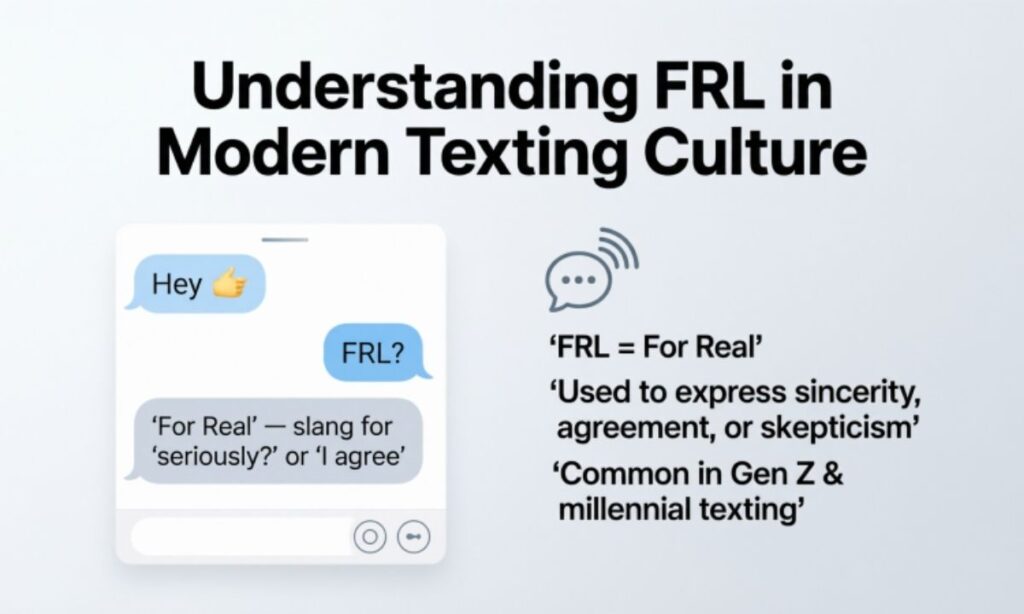
To properly understand FRL, you need to understand something about the environment it lives in. Modern texting culture is a world of speed, compression, and emotional shorthand. People are exchanging dozens or even hundreds of messages a day, often across multiple platforms simultaneously, and the unspoken agreement of that communication style is that brevity is valued. Nobody wants to type out the full phrase “I am being completely serious about this” when three letters will communicate the same thing to anyone who shares the same cultural vocabulary.
FRL sits within a broader ecosystem of sincerity markers in digital communication. It is related to expressions like “no cap,” “deadass,” “on god,” and “fr fr” — all of which serve the same fundamental purpose of telling the person you are communicating with that you are being completely genuine and not performing or joking. In a communication culture where irony, sarcasm, and humor are extremely common, having clear signals of sincerity is actually very important. FRL is one of those signals.
What makes FRL particularly effective as a piece of communication is its clean neutrality. Unlike some sincerity markers that carry strong cultural specificity or can sound performative when used outside their native context, FRL is simple, widely understood, and versatile enough to move across different types of conversations without feeling out of place. It works whether you are talking to your best friend, a romantic interest, an acquaintance, or anyone in between — as long as the setting is casual and the relationship is informal.
The Real Meaning Behind FRL (Emotionally Speaking)
The literal meaning of FRL — for real — only tells part of the story. The emotional function it serves in a conversation goes deeper than simple sincerity confirmation. When someone types FRL, they are doing something quite specific on a social and emotional level: they are asking the person they are communicating with to take them seriously, to meet them at the level of genuine engagement rather than treating what they said as throwaway or casual.
This is actually a form of vulnerability in communication. Saying “for real” is implicitly acknowledging that you care about whether the other person believes you, takes you seriously, or understands that you mean what you said. It is a small act of emotional openness — a tiny lowering of the social guard that says: I am not performing here, I actually mean this. In that sense, FRL is not just an abbreviation. It is a gesture of authenticity in a communication landscape where authenticity can be genuinely hard to convey.
Understanding this emotional dimension changes how you read messages that contain FRL. When a friend sends you a compliment followed by FRL, they are not just saying the nice thing — they are specifically telling you that the nice thing is real and not obligatory. When someone tells you about a difficult situation and adds FRL, they are asking you to recognize the weight of what they are sharing. These are small but meaningful differences in the emotional texture of a conversation.
Where Did FRL Come From?
The expression “for real” has been part of American English informal speech for a very long time, predating the internet by several decades. It emerged in African American Vernacular English and spread through popular music, youth culture, and eventually mainstream American speech over the course of the 20th century. By the time digital communication became the dominant mode of interaction for younger generations, “for real” was already deeply embedded in the casual conversational vocabulary of most American English speakers.
The abbreviation FRL followed naturally from the same process that produced most internet and texting slang — the compression of commonly used spoken expressions into shorter written forms suited to the speed and format of digital messaging. As SMS texting became mainstream in the early 2000s and platforms like AIM, MySpace, and eventually Twitter and Instagram established the conventions of digital casual communication, expressions like “for real” became “fr” and eventually spawned the slightly extended “frl” as an alternative form.
The rise of platforms with character limits helped accelerate the adoption of abbreviations generally, and FRL benefited from that broader cultural push toward shorter, more expressive written communication. By the time TikTok, Snapchat, and Instagram DMs became the primary communication channels of Gen Z users, FRL was already part of a well-established digital vocabulary that younger users absorbed as naturally as any other aspect of the online spaces they grew up in.
How FRL Is Used in Real Conversations
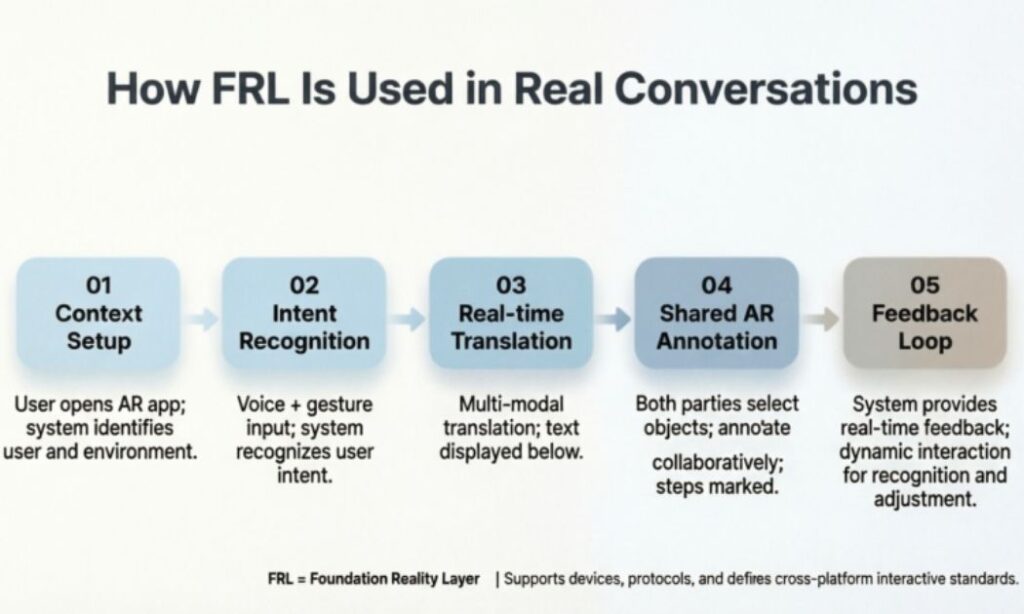
The best way to understand any piece of language is to see it in actual use. Below are everyday examples of FRL appearing in the kind of conversations where it naturally belongs, along with brief notes on what each example communicates beyond the literal words.
Everyday Examples
Example 1 — Giving a genuine compliment:
Person A: “That presentation you did today was actually really impressive.”
Person B: “FRL? That means a lot, I was so nervous about it.”
What it communicates:
Person B is using FRL as a question — checking that the compliment is sincere and not just politeness. This is one of FRL’s common uses: to verify the genuineness of what was just said.
Example 2 — Expressing shared frustration:
Person A: “I can’t believe how long the queue was at that place. We waited 45 minutes.”
Person B: “FRL that is absolutely ridiculous for a Tuesday afternoon.”
What it communicates:
FRL opens the response here as a validation of the other person’s frustration — a way of saying “I genuinely agree with you on this.”
Example 3 — Sharing something personal:
Person A: “I’ve been feeling a lot better lately since I stopped overthinking everything.”
Person B: “FRL I needed to hear that. I’ve been in my head so much recently.”
What it communicates:
Here FRL opens a sincere, emotionally responsive reply. It signals that what follows is a genuine personal reaction rather than a polite or performative one.
Example 4 — Reacting to surprising news:
Person A: “They’re shutting down the coffee shop on the corner next month.”
Person B: “FRL?? No way, I was literally there yesterday.”
What it communicates:
As a question with emphasis, FRL here expresses genuine disbelief and requests confirmation of the surprising information.
FRL vs Other Common Slang Terms
FRL belongs to a family of expressions that all serve similar but slightly different purposes in digital communication. Understanding how it compares to its closest relatives helps clarify exactly when FRL is the right choice and when another expression might serve you better.
| Expression | Full Meaning | Primary Function | How It Differs from FRL |
| FRL | For Real | Sincerity marker, emphasis, disbelief | Base comparison — versatile and widely applicable |
| FR | For Real | Same as FRL — slightly more casual | Shorter, slightly less emphatic than FRL |
| FR FR | For Real For Real | Maximum emphasis on sincerity | Doubling intensifies the sincerity beyond single FRL |
| NGL | Not Gonna Lie | Candid admission of something honest | NGL introduces reluctant honesty; FRL confirms genuine intent |
| TBH | To Be Honest | Sets up an honest opinion | TBH is more introductory; FRL can appear anywhere in a sentence |
| No Cap | No Lie / Seriously | Strong sincerity confirmation | No Cap is more emphatic and slightly more confrontational in tone |
| Deadass | Completely Serious | Maximum seriousness marker | Deadass carries heavier intensity; FRL is lighter and more neutral |
| ISTG | I Swear to God | Extreme emphasis and frustration | ISTG carries emotional urgency that FRL does not always have |
When Should You Use FRL?
Knowing what FRL means is step one. Knowing when to actually use it in your own communication is step two, and getting this right makes a real difference in how naturally and effectively your digital conversations flow.
- When you want to confirm that a compliment, statement, or opinion is completely genuine and not exaggerated
- When you are reacting to surprising or hard-to-believe news and want to express authentic disbelief
- When you are validating a friend’s feelings or experience and want them to know your support is real
- When you are making a bold claim and want to pre-empt any assumption that you are joking
- When you want to add emotional emphasis to something without making the conversation feel heavy or serious
- When someone shares something important and you want to respond with genuine engagement rather than a generic reply
- When texting or messaging in a casual context where formal or full-sentence language would feel stiff
Variations of FRL You Might See
Language in digital spaces never sits still, and FRL has naturally evolved into several related forms that carry slightly different tones or fit different stylistic preferences. Being familiar with these variations means you will not be caught off guard when you encounter them.
| Variation | Appearance | Tone / Use |
| FRL | Standard caps abbreviation | Neutral, widely understood, works everywhere casual |
| frl | Lowercase version | Even more casual, very common in DMs and texts |
| frl? | As a question | Expressing disbelief or requesting confirmation |
| frl tho | With “though” added | Slightly softer; “I actually mean this though” |
| frl frl | Doubled for emphasis | Maximum sincerity — completely serious, no doubt |
| frl no cap | Combined with no cap | Stacking sincerity markers for absolute emphasis |
| FRL 💀 | With skull emoji | Humorously sincere — something is both real and funny |
| frl im dead | Paired with “im dead” | Something is so real or so funny it is overwhelming |
Common Misunderstandings About FRL
Every piece of widely used slang comes with its share of misreadings and misinterpretations, and FRL is no different. These are the most common ways people get confused by or about FRL, and understanding them helps you avoid the same pitfalls.
- Confusing FRL with URL: At a glance, especially on a small phone screen, FRL can occasionally be misread as part of a URL or web address. Context almost always resolves this immediately, but it is worth being aware of.
- Treating it as always question-format: FRL can be used as a question (FRL?) or as a statement (FRL that was amazing). Some people assume it only works one way, but it is flexible in both form and placement.
- Assuming it means sarcasm: Because “for real” can sometimes be said sarcastically in spoken conversation (“Oh sure, for real”), people occasionally read FRL as sarcastic in text. In the vast majority of cases it is completely sincere. Look for additional sarcasm cues before assuming irony.
- Thinking it is only for younger users: While FRL is most associated with Gen Z communication, anyone who uses informal digital communication can and does use it naturally.
- Using it in formal contexts: This is the most consequential misunderstanding — using FRL or any informal slang in a professional or formal communication setting undermines your credibility and signals poor situational awareness.
The Psychology Behind Slang Like FRL (Topical Gap #1)
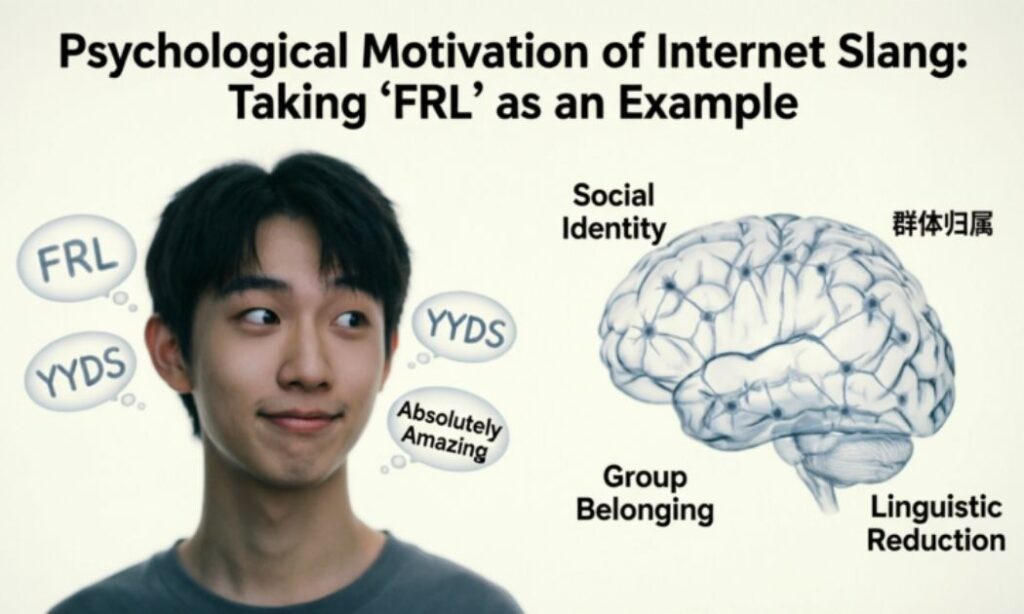
It is easy to look at abbreviations like FRL and see them as pure laziness — shortcuts for people who cannot be bothered to type out full sentences. But that reading completely misses what is actually happening when people reach for expressions like this in their daily communication. The psychology behind slang like FRL is genuinely interesting and reveals a lot about how human communication adapts to its environment.
Insight 1
Brevity = Speed
1. Brevity = Speed
The most obvious psychological driver of slang like FRL is the need for speed in high-volume digital communication. When you are exchanging dozens of messages across multiple conversations every day, the cognitive load of composing full, grammatically complete sentences for every single exchange would be genuinely exhausting. Abbreviations reduce that cognitive load without reducing the emotional content of what is being communicated. FRL does the work of “I want you to know I am being completely sincere about this” in three letters. That is not laziness — that is extraordinary linguistic efficiency.
Insight 2
Emotional Compression
2. Emotional Compression
Slang like FRL also serves the function of emotional compression — packing a significant amount of emotional and relational information into a very compact form. When someone sends “FRL that was so hard to go through,” the FRL is not just saying “I am serious.” It is communicating: I am fully present in this conversation, I genuinely care about what you just shared, and I want you to feel that my response is coming from a real place rather than a polite automatic reaction. That is a lot of relational work for three letters to do, and the fact that it does that work efficiently is evidence of how sophisticated language can be even at its most compressed.
Insight 3
Identity & Belonging
3. Identity & Belonging
Using slang like FRL is also, on a deeper level, an act of social identity and group belonging. Language is one of the most powerful signals of cultural membership that exists, and when people use the same slang with each other they are constantly confirming: I am part of your world, I speak your language, we belong to the same cultural community. This dynamic is especially strong in digital spaces where visual and vocal cues of belonging are absent, making linguistic cues carry even more weight than they do in face-to-face interaction.
Insight 4
Attention Economy
4. Attention Economy
In the attention economy of social media, where content is competing constantly for limited human attention, punchy, familiar slang cuts through in a way that formal language does not. FRL grabs attention because it is recognizable, because it carries emotional charge, and because it signals that what follows or what just came before is worth paying genuine attention to. In that sense, it functions almost like a notification flag embedded in natural language — a small signal that says: this matters, pay attention here.
Advanced Tone & Context Analysis (Topical Gap #2)
One of the things that makes digital communication genuinely challenging is that the same words can carry completely different meanings depending on the tone and context in which they appear. FRL is a perfect example of this phenomenon — it can operate in at least four distinct emotional registers, and reading which one is active in a given conversation requires paying attention to the full context around it.
1. Genuine Tone
The most common use of FRL is in a genuine tone — completely sincere, no irony, no subtext. When someone says “FRL you’re one of the best people I know,” there is nothing hidden or complicated in that message. The FRL is simply a confirmation that the compliment is real and meant with full sincerity. Responses to genuinely-toned FRL messages should match that sincerity — a warm, real response rather than a deflecting or jokey one will land better here.
2. Sarcastic Tone
While FRL is primarily a sincerity marker, it can occasionally be deployed sarcastically — and when it is, the effect is particularly sharp because of the contrast with its usual function. “FRL, the weather is just perfect today” said after a week of rain, or “FRL what a totally normal thing to say” in response to something bizarre, uses the expected sincerity of FRL against itself to create a double meaning. Context is everything here — look for obvious mismatches between the FRL and the surrounding content to identify sarcastic use.
3. Passive-Aggressive Tone
In some contexts, FRL can carry a passive-aggressive quality — especially when used in response to something that has been repeated, dismissed, or ignored. “FRL though, I told you this was going to happen” is technically a sincere statement but carries an undercurrent of frustration that is clearly audible even through text. When FRL appears alongside a statement that has the shape of an “I told you so,” that passive-aggressive quality is almost always present and should be read accordingly.
4. Emotional Tone
When someone is sharing something genuinely difficult, vulnerable, or emotionally significant and pairs it with FRL, the expression takes on a softer and more tender quality. “FRL I have not felt this good in months” or “FRL this has been the hardest week” — in these cases FRL is doing the work of authenticity confirmation in an emotionally loaded context. It is asking the listener to receive the statement with the seriousness and care it deserves, not to brush past it or meet it with humor.
| Tone Type | How FRL Functions | Example | How to Respond |
| Genuine | Pure sincerity marker | “FRL you looked amazing today” | Warm, sincere acknowledgment |
| Sarcastic | Ironic inversion of sincerity | “FRL what a great idea that was 🙄” | Match the humor, acknowledge the sarcasm |
| Passive-Aggressive | Frustrated emphasis | “FRL though I said this weeks ago” | Acknowledge the frustration honestly |
| Emotional | Vulnerability confirmation | “FRL I’ve been struggling lately” | Slow down, respond with care and presence |
FRL in Different Cultures and Regions
Like most English-language internet slang, FRL originated in the United States and spread outward through global digital culture. However, its reception and frequency of use vary meaningfully across different cultural and geographic contexts, and understanding those variations gives a more complete picture of how this expression actually lives in the world.
- United States: FRL is deeply embedded in everyday casual digital communication, especially among Gen Z and younger Millennials. It requires no explanation in most informal contexts and is used across all regions of the country.
- United Kingdom: FRL is recognized and used among younger British users who consume large amounts of American digital content, though British slang culture also has its own strong competing expressions like “proper,” “bare,” and “innit” that serve similar functions.
- Australia and Canada: Usage patterns broadly similar to the United States due to heavy consumption of American cultural content and shared English-language internet culture.
- Non-English Speaking Countries: In countries where English is not the primary language, FRL is primarily encountered among younger users who are highly integrated into global internet culture and consume significant volumes of English-language content. It is recognized more than it is naturally produced in these communities.
- Multilingual Digital Spaces: In online spaces where multiple languages mix, FRL often appears as a borrowed English element within messages that are primarily in another language — a linguistic borrowing that reflects the dominance of English in global internet culture.
Why FRL Matters in Digital Communication
It would be easy to dismiss FRL as a trivial piece of internet slang — three letters that young people throw into their messages without much thought. But looking at it more carefully reveals something genuinely interesting about how human communication evolves and what people actually need from the language they use with each other.
FRL matters because sincerity matters. In a digital communication environment saturated with irony, humor, performance, and carefully constructed self-presentation, the ability to signal genuine honesty and real emotional engagement is actually quite valuable. FRL is one of the tools that people use to cut through the noise of performative digital communication and reach for something more real — to tell the person they are talking with: this is not a performance, I actually mean this, please receive it that way.
Understanding FRL also helps you become a more perceptive and effective digital communicator overall. When you know what it means emotionally as well as literally, you start noticing when people are using it in ways that signal they need more than a quick reply — when they need real acknowledgment, real validation, or real engagement rather than a surface-level response. That kind of perceptiveness makes you a better friend, a better conversation partner, and a more emotionally intelligent participant in the digital spaces where so much of modern life now takes place.
Frequently Asked Question
What does FRL mean in text messages?
FRL means “For Real” in text, used to show honesty or seriousness in a conversation.
Is FRL the same as FR?
Yes, both mean “for real,” but FRL is just a slightly stronger or newer slang version.
How do you use FRL in a sentence?
You can say: “FRL, that movie was amazing,” to show you truly mean it.
Is FRL a slang or acronym?
FRL is a slang acronym commonly used in texting and social media chats.
What does FRL mean on Snapchat?
On Snapchat, FRL still means “for real,” used to express truth or surprise.
When should I use FRL in chat?
Use FRL when you want to emphasize honesty, agreement, or strong feelings.
Is FRL formal or informal language?
FRL is informal slang, not suitable for professional or formal writing.
What is the difference between FRL and FR?
FRL adds extra emphasis, while FR is more commonly used in casual texting.
Why do people say FRL online?
People use FRL to sound more expressive and natural in digital conversations.
Is FRL popular in 2026 texting slang?
Yes, FRL is still popular in 2026, especially among teens and social media users.
Conclusion
FRL is a simple slang term that means “for real” in text messages. It is used to show honesty or strong agreement in a casual way. People often use it in chats, Snapchat, and social media. It helps make conversations feel more natural and expressive.
In short, FRL is popular among teens and online users because it is quick and easy to type. It is not formal language, so it should only be used in casual talks. Understanding FRL helps you keep up with modern texting trends. It makes digital communication more fun and clear.

Rehan is an experienced content writer at fitsname.com, specializing in name-related topics. He creates well-researched, creative, and easy-to-understand content focused on animal names, team names, group names, and unique naming ideas. With a strong passion for words and SEO-friendly writing, Rehan helps readers discover meaningful, catchy, and memorable names for every purpose. His goal is to make name selection simple, fun, and inspiring for everyone.